EOT Crane for Warehouse: The Smart Way to Lift Heavy Loads
Table of Content
EOT Crane for Warehouse: The Smart Way to Lift Heavy Loads
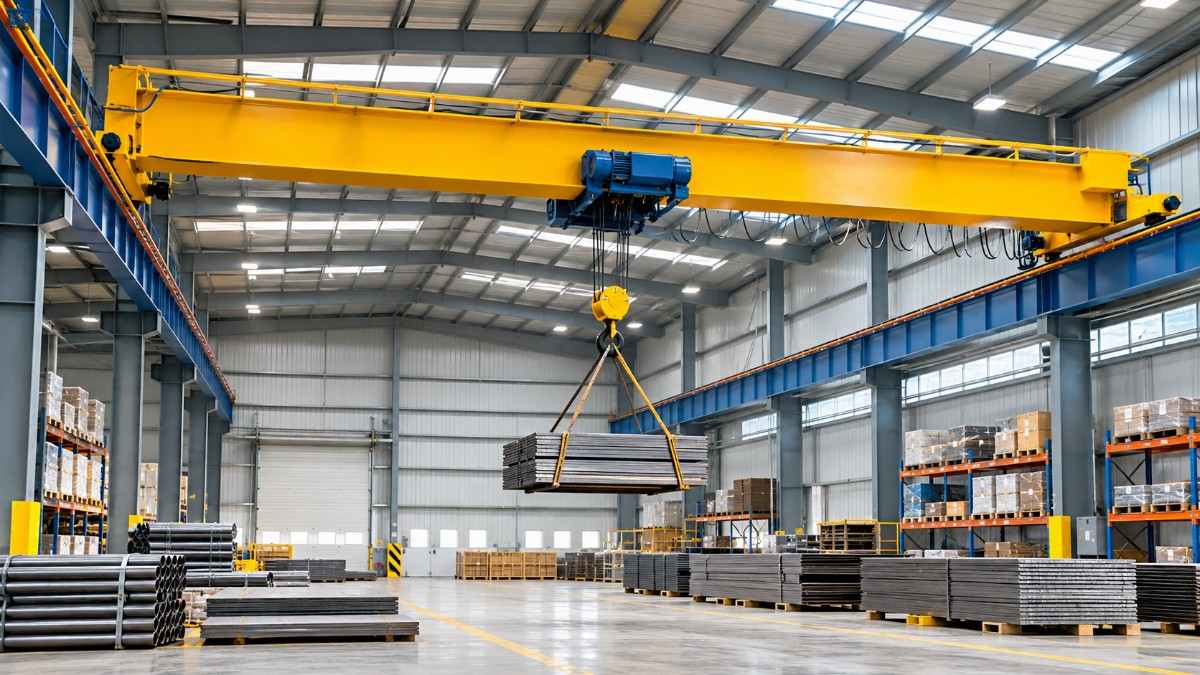
An EOT crane for a warehouse moves the handling overhead, so the floor can be used for storage instead of traffic.
This guide is for warehouse owners, logistics managers, plant heads and project consultants who handle heavy, bulky or awkward loads: steel coils and sheets, machinery, moulds, pipes, cable drums, heavy spares, or palletised goods too heavy for normal handling. It applies whether you are building a new warehouse or adding a crane to an existing shed.
It covers where an overhead crane makes more sense than a forklift, which crane type suits which warehouse layout, the building and sizing checks to make before you order, the features that matter for daily warehouse work, and how to keep costs under control. The guidance comes from how Timeskrane (Times Industrial Engineers Pvt Ltd), a Faridabad-based crane builder and Demag-authorised partner since 2012, plans crane installations for industrial and logistics buildings.
Why Warehouses Are Moving Heavy Handling Overhead
Forklifts are flexible and cheap to start with, and they are the right tool for many warehouses. Once loads get heavy, long or awkward, though, their limits show quickly.
Floor space. A crane runs on the building structure above the stored material. It needs no aisles for turning, so more of the floor can hold stock. In heavy-goods stores, this alone can justify the crane.
Load size and shape. Long pipes, steel sections, sheet bundles, coils and large machines are hard and risky to handle with forks. A crane with the right attachment (lifting beam, C-hook, coil tongs, plate clamps) lifts them from above, balanced and under control.
Reach across the whole floor. An EOT crane covers the full rectangle of its bay, including corners and areas against walls that a forklift can’t reach. Stock can be placed and picked anywhere.
Lifting height. A crane can stack or unstack loads to heights that would need a very large forklift. It can also lift loads directly from a truck parked inside the bay.
Safety and floor damage. Fewer forklift movements mean fewer collisions with racks, people and walls. The floor also avoids the point loads and wear that heavy forklifts cause.
Running cost. An electric crane has no fuel cost, no tyres to replace and no engine to service. Maintenance is planned and predictable.
A crane doesn’t replace forklifts everywhere. Many well-run warehouses use both: the crane for heavy and bulky items in specific bays, and forklifts or pallet trucks for light pallets and dispatch.
EOT Crane vs Forklift: A Quick Comparison
| Factor | EOT crane | Forklift |
|---|---|---|
| Floor space needed | None for handling; floor stays free for storage | Wide aisles for turning and travel |
| Typical loads | Heavy, long, bulky, coils, sheets, machinery | Palletised goods, moderate weights |
| Coverage | Full bay, including corners and wall areas | Limited by aisles and turning space |
| Lifting height | High, limited only by building and hook height | Limited by mast height and stability |
| Running cost | Electricity and planned maintenance | Fuel or battery, tyres, engine service |
| Mobility | Fixed to its bay | Can move between areas and outdoors |
| Best use | Dedicated heavy-handling bays | Flexible, lighter, mixed handling |
The table shows the real trade-off. A crane gives the most value where the same type of heavy handling happens in the same area every day.
Which Warehouse Crane Type Fits Your Building
The right crane depends on the load, the span of the building, the roof structure and how the floor is used. These are the main options.
Single girder EOT crane
A single girder EOT crane is the most common warehouse choice. It is light, quick to install and economical, and it puts less load on the building columns. Timeskrane builds single girder cranes up to 16 t, which covers most steel stockyards, machinery stores and heavy spare parts warehouses. Low-headroom hoists help get the most hook height in sheds with limited roof clearance.
Double girder EOT crane
A double girder EOT crane suits wider spans, heavier loads (up to 50 t from Timeskrane) and warehouses that need the maximum hook height. It is the right choice for heavy coil storage, large machine stores and warehouses attached to heavy manufacturing units.
Underslung crane
An underslung crane hangs from runway beams fixed to the roof structure, so it needs no gantry columns or crane brackets. It gives excellent end approach (the hook gets very close to the walls) and keeps the floor completely clear. Timeskrane builds underslung cranes up to 10 t. They suit lighter warehouse loads, provided the roof structure is designed or checked to carry the crane.
Semi-gantry crane
A semi-gantry crane runs on a rail on the floor on one side and on a building column runway on the other. It is useful along one wall of a warehouse, at loading platforms, or where the building can’t carry a full crane runway on both sides.
Jib crane
A jib crane (up to 5 t) serves a single circular area. In warehouses, jib cranes work well at loading docks, packing stations, inspection bays and repair corners, often alongside a main EOT crane.
KBK light crane system
A Demag KBK light crane system is a modular, ergonomic system for lighter, frequent lifts. It fits picking, packing and assembly areas where people handle moderate loads all day. It can be extended or reconfigured as the layout changes.
For layouts that don’t fit a standard design, such as multiple bays, transfer between bays, or very low headroom, Timeskrane designs tailored crane solutions. Read more: EOT Crane Types Explained and Single Girder vs Double Girder EOT Crane: Which One to Choose.
How to Size an EOT Crane for Your Warehouse
Getting the size right matters more than the brand name on the hoist. Work through these points.
Capacity
Start with the heaviest single item you will lift, then add the weight of the lifting attachment. A lifting beam or coil tong can weigh a good fraction of a tonne. Add a sensible margin if you expect heavier stock in the future. Don’t oversize too much, though: a larger crane costs more and puts more load on the building.
Span and coverage
Span is the distance between the two runway rails. Long-travel length is the length of the bay the crane must cover. Check that the hook can reach every storage location, the truck parking position and any dispatch area. Ask for the hook approach dimensions (how close the hook gets to each wall). These decide how much of the floor is really usable.
Height of lift and headroom
Measure the space from the floor to the underside of the roof structure. Subtract what the crane and hoist need, and check that the hook rises high enough to clear the tallest stack and lift loads over the sides of trucks. In older or lower sheds, low-headroom hoists or an underslung crane can make the difference.
Duty class
Warehouse cranes often run many short cycles every shift. They are usually medium duty (around Class II to Class III under IS 3177, or M4 to M5 in ISO terms). A crane used only for occasional heavy lifts can be lighter duty. A crane handling stock continuously through two or three shifts needs a higher class. An undersized duty class wears out gearboxes, wheels and ropes early.
Speeds and control
Warehouses value fast, smooth handling. VFD drives give soft starts and stops, fine positioning and less load swing, which matters when you are placing loads close to racks or onto trucks. Radio remote control lets the operator walk beside the load, see clearly and stay out of the danger zone.
Check the Building Before You Buy the Crane
Many crane problems in warehouses are really building problems. Most new warehouses in India are pre-engineered buildings (PEB). A PEB is designed for specific loads, and a crane adds heavy moving loads that the original design may not include.
Before ordering an EOT crane for a warehouse, check the following:
- Crane loads in the building design. If the warehouse is new, give the crane data (capacity, span, wheel loads, crane weight) to the PEB designer before the building is finalised. Adding crane brackets later is far more expensive.
- Column brackets and gantry girders. For an existing shed, a structural engineer must confirm that the columns, brackets and gantry girders can carry the crane wheel loads and horizontal forces.
- Roof capacity for underslung cranes. An underslung crane hangs from the roof, so the rafters and purlins must be checked for the extra load.
- Floor rail for semi-gantry cranes. The floor must be strong and level enough for the rail.
- Clearances. Check lights, sprinklers, ducts and skylights that could get in the crane’s way.
- Power supply. Plan the supply point, cable route and the type of power feed (DSL or festoon).
A technical consultation and site survey before you finalise the crane catches these issues early, when they are cheap to fix.
Features That Make Warehouse Cranes Work Better
Beyond the basics, these features make a real difference in day-to-day warehouse handling:
- Reliable hoists. Demag rope hoists for heavier loads and longer lifts, and Demag chain hoists such as the DC-Pro for lighter, frequent lifts
- VFD control on hoisting and travel for smooth, accurate placement
- Radio remote control so operators can work from a safe, clear position
- Overload protection and hoist limit switches as standard
- Anti-collision sensors if two cranes share the same runway
- Travel limit switches and buffers at the ends of the runway
- Warning lights and horns so people on the floor know the crane is moving
- Suitable lifting attachments for your goods, such as lifting beams, C-hooks, coil tongs or plate clamps, chosen with the crane supplier so the hook capacity and headroom allow for them
Warehouse Applications for EOT Cranes
EOT cranes work well in many kinds of warehouses and storage facilities:
- Steel stockyards and service centres: coils, sheets, plates, pipes, bars and structural sections
- Machinery and equipment stores: large machines, motors, gearboxes and heavy components
- Mould and die stores: heavy moulds and dies for plastics, automotive and foundry plants
- Cable and drum stores: heavy cable drums and reels
- Heavy spare parts warehouses: in power, cement, mining and process industries
- Factory-attached raw material and finished goods stores: feeding production lines and loading dispatch trucks
- Third-party logistics warehouses handling heavy industrial cargo
Similar handling challenges appear in heavy industry. See the guides on EOT cranes for steel plants and EOT cranes for foundries.
What a Warehouse EOT Crane Costs and How to Control It
The price of an EOT crane for a warehouse depends mainly on capacity, span, height of lift, duty class, hoist type, controls and any building work needed. The crane price is only part of the total. Also budget for:
- Gantry girders, rails and column brackets (if not already in the building)
- Power supply and DSL or festoon system
- Installation, commissioning and load testing
- Lifting attachments
- An annual maintenance contract
To keep costs under control, specify the crane accurately instead of oversizing it, plan crane loads into the building from the start, choose the right crane type for your structure, and compare quotations on the same specification. For typical price ranges, see EOT Crane Price in India, Wire Rope Hoist Price in India and Electric Chain Hoist Price in India.
Keep Your Warehouse Crane Running
A warehouse crane often runs every shift, so regular maintenance prevents costly stoppages. Include daily operator checks (brakes, limit switches, hooks, wire rope or chain, unusual noise), monthly inspections by a technician, and a full annual inspection with load testing as required. The EOT crane maintenance guide lists the key checks. An annual maintenance contract with the crane supplier makes sure this actually happens.
How Timeskrane Supports Warehouse Crane Projects
Timeskrane (Times Industrial Engineers Pvt Ltd) designs and fabricates cranes in Faridabad, with roots going back to 1988, and has been a Demag-authorised crane builder since 2012. For warehouse projects, Timeskrane offers:
Products
- Single girder EOT cranes up to 16 t
- Double girder EOT cranes up to 50 t
- Underslung cranes up to 10 t
- Jib cranes up to 5 t
- Semi-gantry cranes and tailored crane solutions
- Demag KBK light crane systems
- Demag DHR, DVR and DH rope hoists
- Demag DC chain hoists
Services
- Site survey, technical consultation and crane layout planning
- Coordination with PEB and structural designers
- Installation, commissioning and load testing
- Annual maintenance contracts
- Service and genuine spares for Demag and KONE cranes
Warehouses across North India can also explore Timeskrane’s EOT crane manufacturer in Delhi NCR page. If you are comparing suppliers, read Top EOT Crane Manufacturers in India.
Turn Your Warehouse Floor Into Storage, Not Traffic
An EOT crane changes how a warehouse uses its space. Heavy handling moves overhead, the floor fills with stock instead of aisles, and loads move faster and more safely. The best results come from matching the crane type to the building, sizing it for the real loads and duty, and planning the structure before installation.
As a next step, write down the heaviest item you handle, the bay dimensions and the clear height of your warehouse. Share them with the Timeskrane team for a site survey and a crane recommendation that fits your building.
Ready to lift heavy loads the smart way?
Get a site survey and a warehouse crane plan from Timeskrane.
📞 +91 98100 40296 | +91 98109 01759 | +91 84487 81498
✉️ Marketing@timesmarketing.com
Request an EOT Crane Quotation →
Need a Custom Lifting Solution?
Let’s Talk!
Looking for a reliable partner for your next industrial project?
- Expert Consultation
- Pan-India Service