How to Choose the Right Electric Wire Rope Hoist Manufacturer
Table of Content
How to Choose the Right Electric Wire Rope Hoist Manufacturer
That is why choosing the right electric wire rope hoist manufacturer matters more than almost any other decision in a lifting project.
This guide is for plant engineers, maintenance managers, project consultants and purchase teams. Maybe you are buying a hoist for a new EOT crane, replacing an old hoist on an existing crane, or comparing quotations that look alike on paper but differ widely in price. The aim is simple: help you pick a manufacturer whose hoist will still run reliably years from now, not just pass the commissioning load test.
It covers how to define your requirement, how to check whether you need a rope hoist at all, the technical and commercial checks that separate good manufacturers from weak ones, the warning signs to watch for, and the questions to ask before you place an order. The guidance comes from how Timeskrane (Times Industrial Engineers Pvt Ltd), a Faridabad-based crane builder and Demag-authorised partner since 2012, specifies and supports rope hoists for industrial customers.
Define Your Application Before You Shortlist Manufacturers
Most bad hoist purchases start with a vague enquiry. “Need 10 t wire rope hoist” leaves every supplier free to quote what suits them, and the quotations can’t be compared. Before contacting any electric wire rope hoist manufacturer, write down the following.
Safe working load. Use the heaviest load you will actually lift, plus the weight of the lifting tackle (slings, spreader beams, magnets or grabs). Allow a margin if heavier equipment may be added later.
Height of lift. This is the vertical distance the hook must travel, from its lowest position to its highest. It decides the drum length and rope length, and it often decides the hoist size more than the capacity does.
Duty and usage pattern. Note how many lifts per hour, how many hours per day, and how close to full load most lifts are. A maintenance hoist used twice a month and a production hoist running every shift need completely different designs, even at the same capacity.
Headroom and approach. Measure the space between the runway or girder and the roof. Note how close the hook must get to walls or columns. In tight buildings, a low-headroom design can save you from having to modify the building.
Speeds and control. Decide on the hoisting and trolley speeds you need, and whether you need precise positioning (creep speed or variable speed through a VFD).
Environment. Record ambient temperature, dust, humidity, outdoor exposure, corrosive fumes or hazardous areas.
Mounting arrangement. Note whether the hoist will be on a single girder crane, a double girder crane, a monorail, or fixed in place.
With this information, you can judge manufacturers on how well they answer your requirement, rather than on who quotes the lowest price.
Confirm That a Wire Rope Hoist Is the Right Choice
A wire rope hoist isn’t always the best answer. Electric chain hoists are compact, cost less and suit lighter loads and shorter lifts. Wire rope hoists are generally the better choice when:
- The load is heavy, usually several tonnes and above
- The lift height is long
- Hoisting speeds need to be higher
- The duty is frequent or continuous
- The hoist will run on a single or double girder EOT crane in a production environment
For lighter workstation lifts, short lift heights and maintenance points, an electric chain hoist such as the Demag DC-Pro chain hoist is often more practical. The full chain hoists range covers these uses. A good manufacturer will tell you honestly when a chain hoist fits better, even if it means a smaller order.
Read more: Wire Rope Hoist Price in India and Electric Chain Hoist Price in India
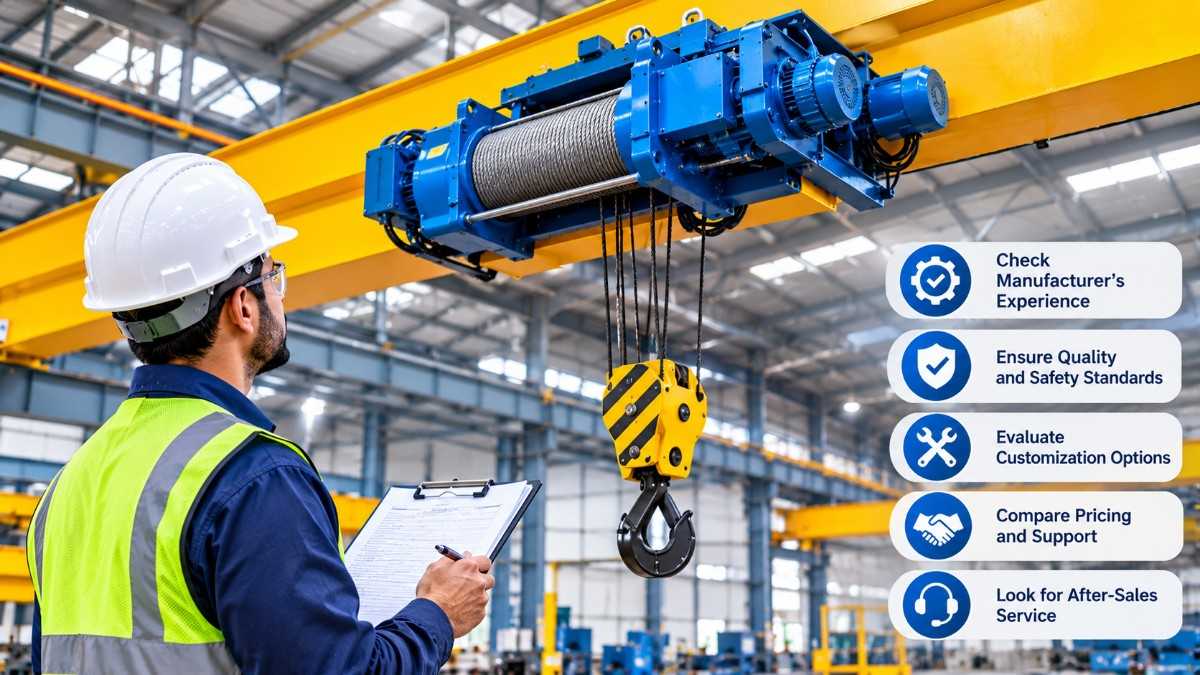
9 Checks for Choosing an Electric Wire Rope Hoist Manufacturer
Once your requirement is clear, assess each manufacturer against these nine checks.
1. Correct duty classification
Duty classification is the most important factor in hoist life, and also the one most often fudged. Hoist mechanisms are classified under ISO 4301 / FEM 9.511 groups (such as 1Bm, 1Am, 2m, 3m, or M3 to M7). The classification combines the load spectrum (how heavy the lifts usually are) with the running time.
A reliable manufacturer will ask about your usage pattern before proposing a duty class. A weak one will put “M5” or “FEM 2m” on every quotation without asking. Ask each supplier to show how they arrived at the duty class. An undersized classification is the most common reason gearboxes, ropes and brakes fail early.
2. Compliance with Indian and international standards
In India, IS 3938 covers electric wire rope hoists. IS 2266 covers steel wire ropes for general engineering purposes, and IS 3177 and IS 807 apply when the hoist is part of an EOT crane. A good manufacturer will state which standards the hoist is designed and tested to, and will put that in writing in the quotation and test certificate.
3. Quality of critical components
Look past the brochure and ask what is inside. The components that decide hoist life are:
- Wire rope: Construction, tensile grade, and whether it is galvanised. Good hoists use high-grade ropes matched to the drum and sheave diameters.
- Rope drum and rope guide: A properly grooved drum and an effective rope guide prevent the rope from jumping grooves and stop uneven wear.
- Gearbox: Hardened, precision-cut gears in an oil bath, sized for the duty class.
- Brake: A fail-safe brake that engages automatically when power is lost, with easy adjustment and long lining life.
- Motor: Insulation class, protection rating (IP55 or better for industrial use), and thermal protection.
- Hook and bottom block: A forged hook with a safety latch, and a bottom block with bearings in good condition.
Manufacturers that build on proven hoist platforms such as the Demag DHR, DVR and DH series give you component quality you can check, along with spare parts that stay available for years. Explore the Demag rope hoists range from Timeskrane.
4. Built-in safety features
Any electric wire rope hoist you buy should include, at a minimum:
- Overload protection that stops hoisting above the rated load
- Upper and lower hook limit switches, with an emergency limit for the upper position
- A fail-safe electromagnetic brake
- Motor thermal protection
- Phase-failure and phase-reversal protection
- An emergency stop on the pendant or remote
- A hook safety latch
Better hoists add features such as slack-rope detection, load monitoring and operating data logs. These help maintenance teams plan servicing before a failure, not after one.
5. Controls and speed options
For production work, two-speed or VFD-controlled hoisting and travel make a big difference. VFD control reduces load swing, gives fine creep speed for accurate placement, cuts shock loads on the gearbox and structure, and extends brake life. Ask whether the manufacturer offers pendant control, radio remote control, or both, and whether the control panel is built to suit your site conditions.
6. Integration with your crane
A hoist rarely works alone. It runs on a crane girder or monorail, and its dimensions affect the whole crane design. A manufacturer who also designs and builds cranes can match the hoist trolley, girder profile, end approach and headroom far better than a supplier who only sells hoists.
This matters most for:
- Single girder EOT cranes, where low-headroom monorail hoists maximise hook height
- Double girder EOT cranes, where double-rail crab trolleys carry heavier loads
- Underslung cranes, where the hoist must suit a suspended girder
- Monorail systems along production lines
If you are still deciding on the crane type, read Single Girder vs Double Girder EOT Crane: Which One to Choose.
7. Testing and documentation
Ask what testing happens before dispatch and after installation. A reliable manufacturer carries out factory checks and a load test, and supplies:
- A test certificate with the test load and results
- Rope and hook certificates
- An operation and maintenance manual
- Electrical drawings and a spare parts list
- Warranty terms in writing
If a supplier is reluctant to provide documents, treat that as a serious warning.
8. Installation and after-sales service
The best hoist in the world will still fail if it is installed badly or never serviced. Check whether the manufacturer has its own installation team, how quickly they respond to a breakdown, and whether they offer an annual maintenance contract. For plants that run continuously, a supplier within reasonable travelling distance makes a real difference to downtime.
9. Total cost of ownership, not purchase price
A cheaper hoist with an undersized duty class, a basic brake and no VFD can cost far more over five years in breakdowns, replacement ropes and lost production. When comparing quotations, consider:
- Expected service life at your duty class
- Cost and availability of spare parts
- Energy consumption (VFD drives use less power and reduce wear)
- Maintenance intervals and service costs
- The cost of downtime in your operation
For a clearer picture of how specifications affect pricing, see Wire Rope Hoist Price in India.
Wire Rope Hoist Configurations and Where They Fit
Knowing the main configurations helps you check that the manufacturer has proposed the right one.
| Configuration | How it is mounted | Best suited for |
|---|---|---|
| Foot-mounted / stationary hoist | Fixed to a structure or frame | Fixed lifting points, winch-type duties, special machines |
| Normal-headroom monorail hoist | Hangs below a single girder or I-beam | Monorails and single girder cranes where headroom isn’t tight |
| Low-headroom monorail hoist | Hoist body sits beside the girder | Single girder cranes in buildings with limited roof height |
| Double-rail trolley (crab) | Runs on rails on top of two girders | Double girder EOT cranes, heavier loads, maximum hook height |
| Articulated / curved-track trolley | Runs on curved monorail tracks | Production lines and processes that follow a curved path |
A manufacturer who proposes a normal-headroom hoist when your building calls for low headroom, or a monorail hoist where a double-rail crab would give better hook height, hasn’t studied your site properly.
Questions to Ask Before You Place the Order
Use these questions in your technical discussion with every shortlisted manufacturer:
- How did you decide the duty class for my application?
- Which standards is the hoist designed and tested to?
- What are the rope specification, drum diameter and expected rope life?
- What brake type is used, and how is it adjusted?
- Which safety devices come as standard, and which are optional?
- Is VFD control included for hoist and travel motions?
- What are the hook approach dimensions and headroom requirement?
- Who installs, tests and commissions the hoist?
- What does the warranty cover, and for how long?
- How quickly can you supply spare parts, and are they kept in stock in India?
- Do you offer an annual maintenance contract?
- Can you share references from similar installations?
A confident manufacturer will answer these clearly. Vague or evasive answers tell you a lot.
Red Flags When Comparing Wire Rope Hoist Suppliers
Be cautious if you see any of the following:
- The same duty class on every quotation, whatever your usage pattern
- No mention of standards, or no test certificate offered
- A price far below other quotations, with no clear reason such as a lower specification
- Missing safety devices, such as no overload protection or no emergency upper limit
- Unclear brand or origin of key components like motors, brakes and ropes
- No in-house installation or service team, with everything outsourced to unnamed contractors
- No spare parts commitment, or long lead times for basic parts
- No site visit or headroom check before quoting a hoist for an existing building
A technical consultation and site survey before you finalise the order helps you avoid most of these problems.
Why Industries Choose Timeskrane for Wire Rope Hoists
Timeskrane (Times Industrial Engineers Pvt Ltd) is a Faridabad-based crane builder with roots going back to 1988, and a Demag-authorised crane builder since 2012. Because Timeskrane designs and fabricates the cranes as well as supplying the hoists, the hoist, trolley, girder and controls are engineered as one system.
Hoists and lifting equipment
- Demag rope hoists, including the DHR, DVR and DH series, for monorails, single girder and double girder cranes
- Demag DC chain hoists, including the DC-Pro, for lighter and workstation lifting
- Demag KBK light crane systems for ergonomic handling in workshops and assembly lines
Cranes
- Single girder EOT cranes up to 16 t
- Double girder EOT cranes up to 50 t
- Underslung cranes up to 10 t
- Jib cranes up to 5 t
- Semi-gantry cranes and tailored crane solutions for non-standard layouts
Services
- Site survey and technical consultation
- Installation, commissioning and load testing
- Annual maintenance contracts
- Service and genuine spares for Demag and KONE cranes and hoists
Timeskrane supplies lifting solutions for steel plants, foundries, fabrication shops, warehouses and heavy engineering units. Read the industry guides on EOT cranes for steel plants and EOT cranes for foundries. Customers across North India can also explore Timeskrane’s EOT crane manufacturer in Delhi NCR page.
Choose the Manufacturer, Not Just the Hoist
An electric wire rope hoist is a long-term commitment. Its duty class, components and safety systems decide how long it lasts. The manufacturer’s engineering, testing and service decide how much that life costs you. The best choice is a manufacturer who asks the right questions about your application, puts standards and test results in writing, and is still there to support the hoist years after commissioning.
As a next step, write down your load, lift height, headroom and daily usage, and send them to the Timeskrane team for a correctly classified hoist recommendation.
Need the right wire rope hoist for your crane?
Get an engineered recommendation and a clear quotation from Timeskrane.
📞 +91 98100 40296 | +91 98109 01759 | +91 84487 81498
✉️ Marketing@timesmarketing.com
Request a Quotation →
Need a Custom Lifting Solution?
Let’s Talk!
Looking for a reliable partner for your next industrial project?
- Expert Consultation
- Pan-India Service
