
EOT Crane Price in India 2026 Complete Cost Guide by Capacity
Table of Content
EOT Crane Price in India 2026 Complete Cost Guide by Capacity
turing plant, expanding your warehouse, or replacing an aging crane, the first question is always the same — how much does an EOT crane cost in India?
If you are new to overhead lifting equipment, it helps to first understand what makes EOT cranes essential for heavy industries — because the right crane specification directly determines the right price bracket for your requirement.
The honest answer: it depends on several factors — lifting capacity, span, lift height, duty class, girder type, and the level of customization required. There is no single price that fits every application.
This guide breaks down EOT crane prices in India for 2026 across every major capacity — from 1 ton to 50 ton — along with the key cost factors, what is included in a typical quote, and what to watch out for when comparing suppliers.
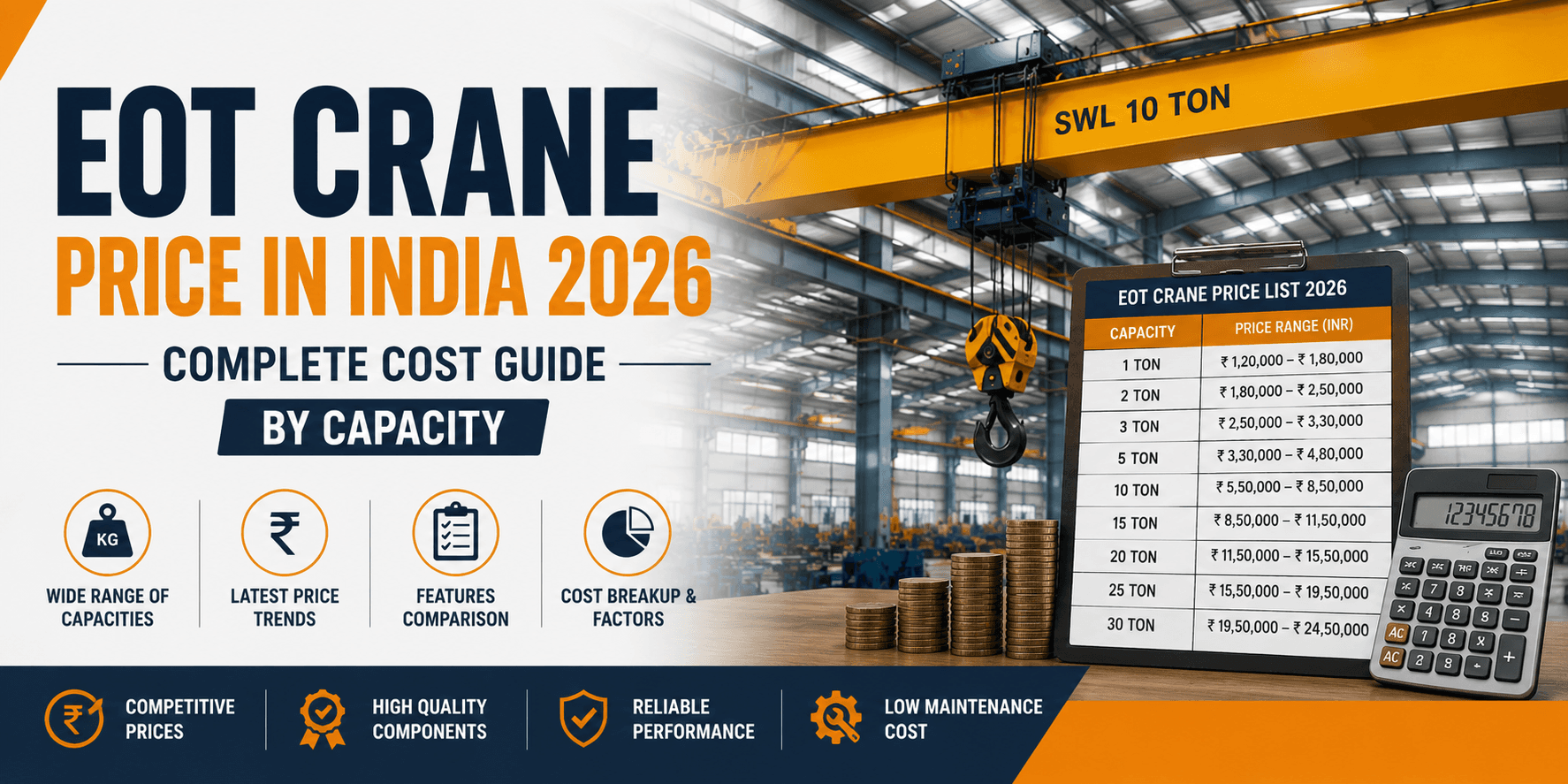
EOT Crane Price in India 2026 — Capacity-Wise Cost Ranges
The prices below are indicative market ranges for standard EOT cranes with a typical span of 10–15 metres and lift height of 6 metres, supplied with standard electrical equipment and pendant control. Prices are approximate, exclude GST, and vary based on manufacturer, configuration, and site requirements. Always get a detailed technical quotation for your specific application.
1 Ton EOT Crane
Approximate Range: ₹3.5 lakh – ₹6 lakh
Type: Single girder, underslung or top running
Common use: Light assembly, small workshops, tool rooms
2 Ton EOT Crane
Approximate Range: ₹5 lakh – ₹9 lakh
Type: Single girder top running
Common use: General fabrication, auto component plants
3 Ton EOT Crane
Approximate Range: ₹7 lakh – ₹12 lakh
Type: Single girder top running
Common use: Light to medium manufacturing, warehouses
5 Ton EOT Crane
Approximate Range: ₹10 lakh – ₹18 lakh
Type: Single girder (up to 18m span) or double girder
Common use: Steel fabrication, cement plants, general industry — the most popular capacity segment in India
7.5 Ton EOT Crane
Approximate Range: ₹15 lakh – ₹24 lakh
Type: Single or double girder
Common use: Medium-duty manufacturing, engineering workshops
10 Ton EOT Crane
Approximate Range: ₹20 lakh – ₹35 lakh
Type: Double girder
Common use: Heavy fabrication, structural steel, auto manufacturing
15 Ton EOT Crane
Approximate Range: ₹30 lakh – ₹50 lakh
Type: Double girder
Common use: Heavy industry, forging, press shops
20 Ton EOT Crane
Approximate Range: ₹45 lakh – ₹75 lakh
Type: Double girder
Common use: Steel plants, heavy engineering, large foundries
25 Ton EOT Crane
Approximate Range: ₹60 lakh – ₹95 lakh
Type: Double girder
Common use: Port handling, large manufacturing, infrastructure projects
32 Ton EOT Crane
Approximate Range: ₹80 lakh – ₹1.25 crore
Type: Double girder, heavy duty
Common use: Shipyards, large steel plants, heavy fabrication
50 Ton EOT Crane
Approximate Range: ₹1.25 crore – ₹2.2 crore
Type: Double girder, heavy/extra heavy duty
Common use: Steel mills, large foundries, offshore fabrication, defence
Important: These are approximate indicative ranges only. Actual prices vary significantly based on span, lift height, duty class, hoist type, control system, and site conditions. Contact Timeskrane for a detailed quotation matched to your exact requirement.
Single Girder vs Double Girder EOT Crane — Price Difference
The girder type is the single biggest factor affecting price within any given capacity. If you are evaluating both options, our detailed guide on choosing the right single girder crane for your facility covers the selection criteria in depth — including when single girder makes technical and financial sense versus when double girder is the right call.
Single Girder EOT Crane
Typically 30–45% lower cost than double girder for the same capacity.
Best for: Up to 10 ton capacity, spans up to 20 metres, light to medium duty (M3–M5).
Limitation: Not suited for very long spans, heavy duty cycles, or capacities above 10 ton.
Double Girder EOT Crane
Higher upfront cost, but necessary for capacities above 10 ton, long spans, or heavy duty class.
Best for: 10 ton and above, spans beyond 20 metres, M5–M8 duty class, cabin operation, special attachments.
Advantage: Better load control, longer service life, supports more complex lifting configurations.
For capacities between 5 ton and 10 ton, both types are available. The choice depends on your span, duty cycle, and headroom constraints — not just price.
What Factors Affect EOT Crane Price in India?
Understanding what drives the cost helps you compare quotes accurately and avoid paying for things you do not need — or missing things you do.
1. Lifting Capacity (SWL) : The most obvious factor. Every doubling of capacity does not double the price — structural and mechanical requirements increase non-linearly. Moving from 5 ton to 10 ton typically increases price by 80–100%.
2. Span : Span is the distance between the crane rails. Standard spans are 10–15 metres. Every extra metre beyond standard adds to girder steel weight and fabrication cost. A 25-metre span crane costs significantly more than a 15-metre span crane of the same capacity.
3. Lift Height : Standard lift height is 6 metres. Extra lift height means longer wire rope, larger drum, taller end trucks, and longer festoon cable. A crane with 12-metre lift height typically costs 8–15% more than the same crane at 6 metres.
4. Duty Class (M Class) : Cranes are classified M1 to M8 based on usage intensity. An M7 crane built for 24/7 steel plant operation uses heavier motors, stronger gearboxes, and more robust brakes than an M3 workshop crane of the same capacity. Duty class can add 20–40% to the base price.
5. Type of Hoist : Wire rope hoists are standard for most industrial applications. Chain hoists are used for lower capacities and lighter duty. Special hoists — explosion-proof, stainless steel, or with variable frequency drives — add significant cost.
6. Control System : Standard pendant control is included in the base price. Radio remote control typically adds ₹50,000–₹1.5 lakh depending on capacity. Cabin control for cranes above 20 ton adds ₹2–5 lakh depending on cabin specification.
7. VFD (Variable Frequency Drive) : VFD drives on hoist and travel motors allow smooth speed control, soft starts, and reduced mechanical stress. They add approximately ₹1–3 lakh per axis depending on motor size but significantly extend the life of mechanical components and improve load handling precision.
8. Special Features : Anti-sway systems, load weighing displays, CCTV on hook, automatic lubrication, and SCADA integration all add to the price. These are typically justified for high-value load handling or automated facilities.
9. Civil & Structural Work : The crane price quoted by the manufacturer typically covers only the crane itself. Runway beam fabrication and erection, building columns, civil foundation work, and electrical supply to the crane panel are separate costs that can add ₹5–30 lakh depending on the facility.
10. Installation & Commissioning : Most reputable manufacturers include basic installation and commissioning in the crane supply price for standard configurations. Always confirm this in writing before signing the order.
What Is Included in a Standard EOT Crane Quote?
When you receive a quotation, check whether the following are included or excluded:
Typically Included:
- Crane bridge with end trucks
- Hoisting mechanism (hoist, wire rope, hook block)
- Long travel and cross travel drive with motors and gearboxes
- Control panel and pendant control
- Limit switches (upper hoist, travel)
- Festoon cable system
- Factory testing before dispatch
- Basic installation and commissioning at site
Typically Excluded — Clarify Before Ordering:
- Runway beam fabrication and erection
- Civil and foundation work
- Power supply cable from MDB to crane panel
- Radio remote control (if required)
- Load test certificate fees
- Freight and insurance to site
- GST (18% applicable)
- Annual maintenance contract
A low headline price that excludes most of the above can end up being more expensive than a comprehensive quote that includes them. Always compare on a delivered-and-commissioned basis.
EOT Crane Price vs Cheap Alternatives — What You Risk
The Indian market has many crane suppliers at very low price points. Knowing what to look for in a reliable EOT crane manufacturer before you compare quotes will help you identify which suppliers are cutting corners and which are genuinely offering value.
Common corners cut by low-price suppliers:
Motor quality — Undersized or low-grade motors overheat under load, fail prematurely, and are expensive to replace.
Wire rope grade — Substandard wire rope has shorter fatigue life and higher risk of sudden failure under load.
Structural steel — Thinner plate sections reduce weight and cost but compromise long-term rigidity and fatigue resistance.
Brake quality — Budget brakes may function initially but wear faster and lose holding capacity under thermal stress.
No load testing — Reputable manufacturers factory-test every crane before dispatch. Many budget suppliers skip this entirely.
No IS certification — Cranes that do not conform to IS:3177 and IS:807 are non-compliant under the Factories Act and create legal liability for the buyer.
The difference between a well-built crane and a cheap one often becomes apparent at the 3–5 year mark — through higher maintenance costs, more frequent breakdowns, and a shorter service life. Over a 15–20 year crane lifespan, the cheapest crane almost always costs more in total.
EOT Crane Running Cost — Beyond the Purchase Price
The purchase price is only the beginning. A 5 ton EOT crane operated in a medium-duty factory will typically incur ongoing costs throughout its life. Understanding these helps you calculate true total cost of ownership — and justify investing in a better crane upfront.
For a detailed breakdown of what ongoing maintenance involves and how to structure it, refer to our EOT crane preventive maintenance checklist which covers daily, weekly, monthly, and annual requirements.
Approximate annual running costs for a 5 ton EOT crane (medium duty):
Annual preventive maintenance: ₹40,000 – ₹1.2 lakh
Wire rope replacement (every 3–5 years): ₹15,000 – ₹80,000
Brake lining replacement (every 2–3 years): ₹8,000 – ₹25,000
Gearbox oil changes (annually): ₹3,000 – ₹12,000
Annual load test and certification: ₹8,000 – ₹25,000
Motor rewind or replacement (every 8–12 years): ₹30,000 – ₹1.5 lakh
Electrical components (contactors, limit switches, cables): ₹15,000 – ₹50,000 annually
A well-maintained crane from a quality manufacturer will have significantly lower running costs and a longer productive life than a budget crane. Factor total cost of ownership — not just purchase price — into your buying decision.
How to Get the Right EOT Crane for Your Budget
Step 1 — Define your actual requirement
Capacity with safety margin, span, lift height, duty class, and any special requirements. Oversizing wastes money; undersizing creates safety and reliability problems.
Step 2 — Get at least 3 technical quotations
Ensure all quotes are for the same specification so you are comparing like for like. A quote 30% cheaper may be for a single girder instead of double girder, or M4 instead of M5 duty class.
Step 3 — Visit the manufacturer's factory if possible
A plant visit tells you more about quality and manufacturing capability than any brochure. Check whether they do factory load testing before dispatch.
Step 4 — Check certifications and compliance
IS:3177 and IS:807 compliance, Factories Act load test capability. Ask for sample load test certificates from previous installations.
Step 5 — Evaluate after-sales support
Spare parts availability, service response time, and whether the manufacturer has a service team that can reach your location. This matters as much as the purchase price — especially for M6–M8 duty applications. Understanding what sets a great EOT crane manufacturer apart from the rest will help you ask the right questions during this evaluation.
Conclusion
EOT crane prices in India in 2026 range from approximately ₹3.5 lakh for a 1 ton light-duty crane to over ₹2 crore for a 50 ton heavy-duty installation. These are indicative ranges — your actual cost depends on span, lift height, duty class, and the specific features your operation requires.
The right price is not the lowest price. It is the price that delivers the capacity, duty class, and reliability your operation actually needs — and that continues to deliver value over a 20-year service life.
At Timeskrane, we manufacture EOT cranes under the TK Crane brand with full IS:3177 and IS:807 compliance, factory load testing on every unit, and a certified service team across India. We provide detailed technical quotations with complete scope clarity — so you know exactly what you are buying before you commit.
Get a customised EOT crane price quote for your requirement:
https://www.timeskrane.com/contact
Frequently Asked Questions
What is the price of a 5 ton EOT crane in India in 2026?
A standard 5 ton single girder EOT crane with 10–15 metre span and 6 metre lift height costs approximately ₹10 lakh to ₹18 lakh excluding GST. Double girder configuration for the same capacity starts from around ₹16 lakh. These are indicative ranges — actual price depends on span, duty class, hoist type, and features.
What is the price of a 10 ton EOT crane in India?
A 10 ton double girder EOT crane in standard configuration costs approximately ₹20 lakh to ₹35 lakh excluding GST. Higher spans, VFD controls, or heavy duty class can push the price above ₹40 lakh.
Is GST applicable on EOT cranes in India?
Yes. EOT cranes attract 18% GST. Always check whether the quoted price is inclusive or exclusive of GST — most manufacturers quote ex-GST.
What is the difference between EOT crane price and gantry crane price?
Gantry cranes run on ground-level rails rather than building-mounted runways and are generally 15–30% more expensive than equivalent EOT cranes for the same capacity, due to the additional leg and ground rail structure.
How long does an EOT crane last?
A well-maintained EOT crane from a quality manufacturer typically has a productive service life of 20–25 years. Cranes operated in heavy duty applications and maintained properly can reliably reach 15–20 years of service.
Can I get an EOT crane on EMI or lease in India?
Yes. Many manufacturers and equipment finance companies offer term loans, lease financing, and hire-purchase arrangements. SIDBI, HDFC Bank, and equipment NBFCs typically finance crane purchases for MSMEs.
Recent Posts
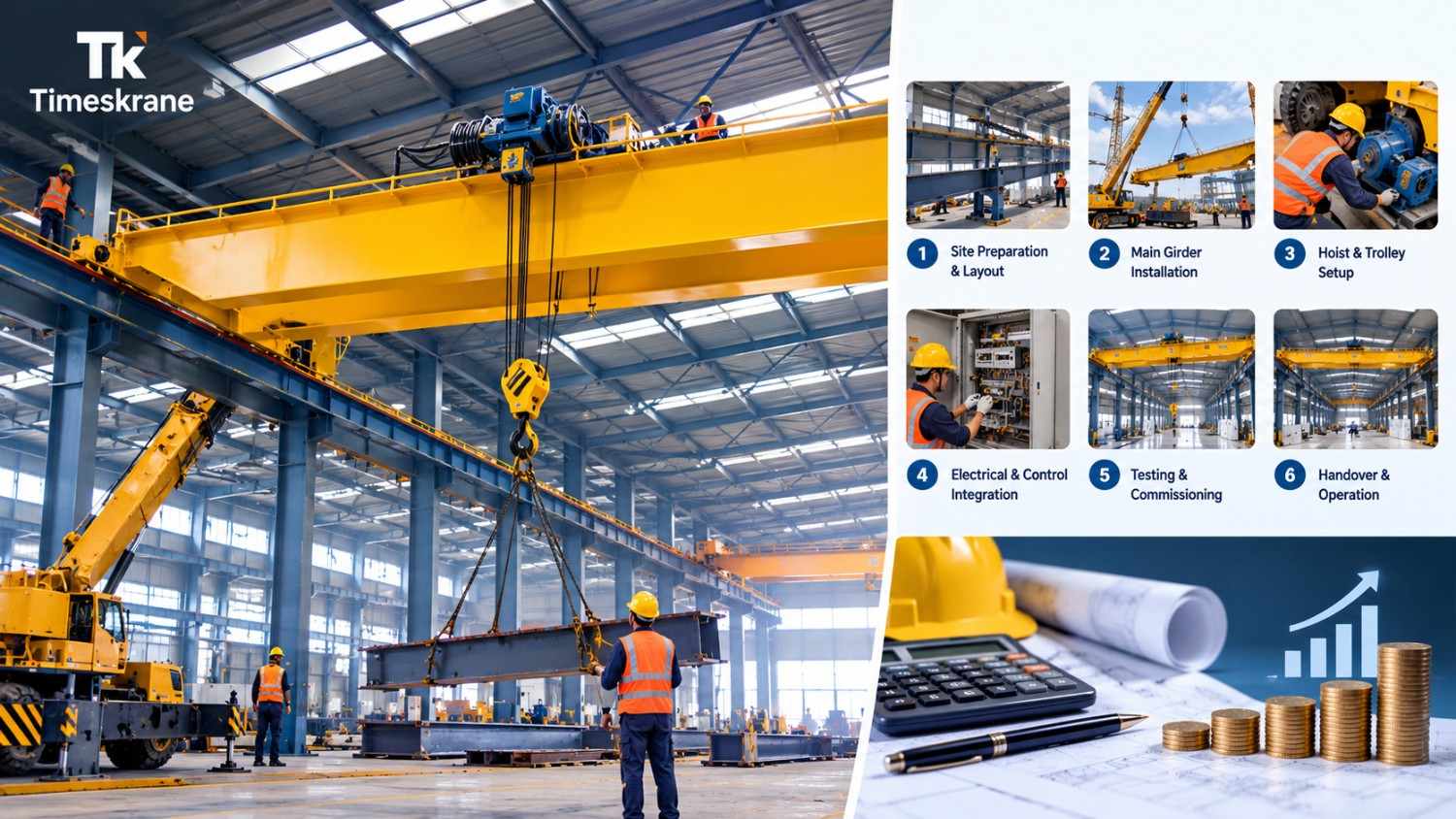
EOT Crane Installation Process and Cost in India
The complete EOT crane installation process in India, covering site survey, runway beams, load testing, and what installation actually costs beyond the crane price.
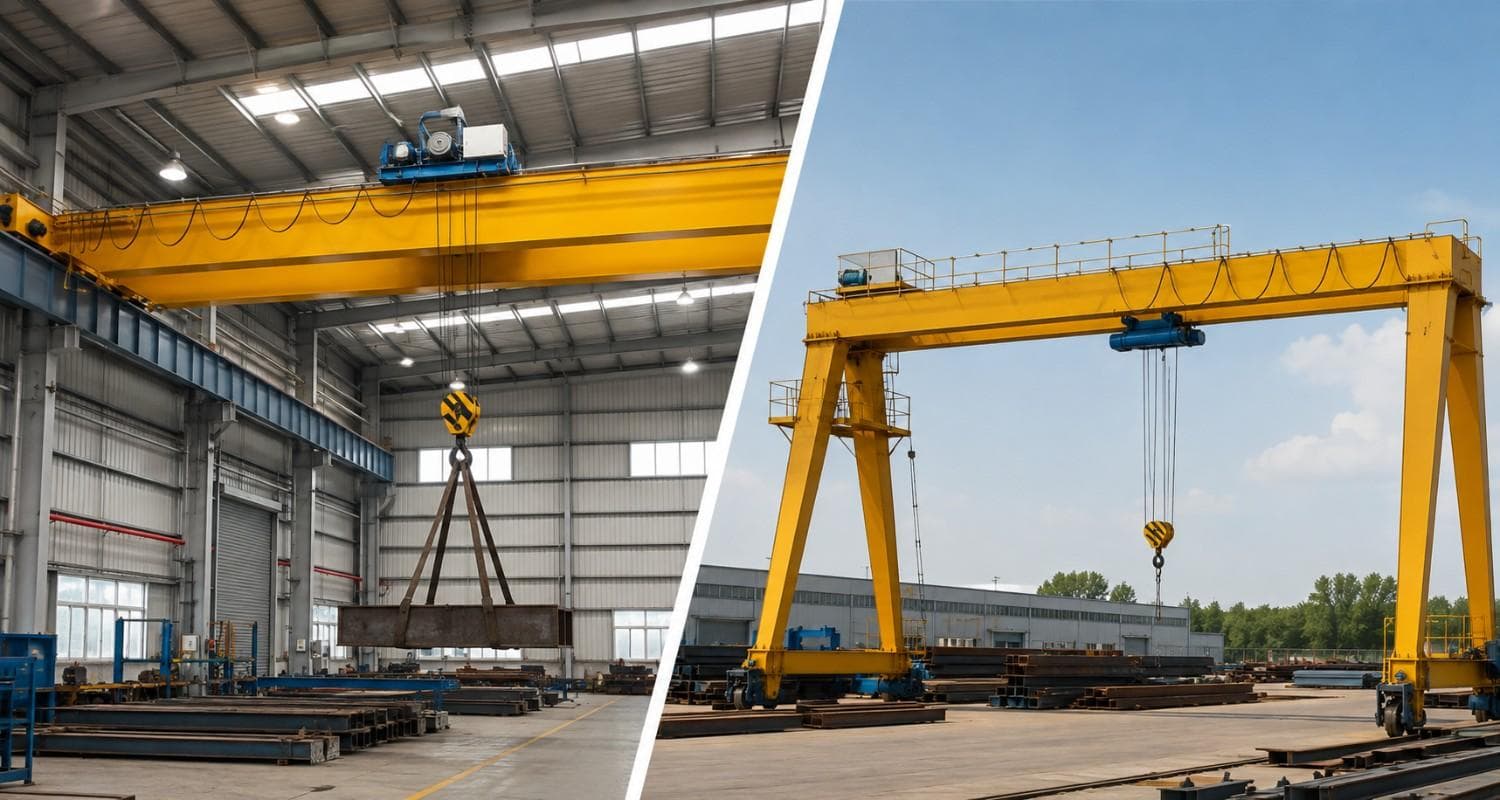
EOT Crane vs Gantry Crane: Which One Does Your Factory Actually Need?
EOT cranes and gantry cranes both lift heavy loads, but they suit very different factories. This guide walks through a simple decision tree covering building structure, floor space, budget, and indoor vs outdoor use, so you can confidently choose the right crane for your facility.

EOT Crane Safety Compliance in India
IS 3177, IS 807, Factories Act rules, and how third-party load testing and certification work for EOT cranes in India.

EOT Crane AMC Cost & Whats Included in 2026
What's actually included in an EOT crane AMC, how comprehensive and non-comprehensive contracts differ, and what drives the cost in India.
Need a Custom Lifting Solution?
Let’s Talk!
Looking for a reliable partner for your next industrial project?
- Expert Consultation
- Pan-India Service