
Preventive Maintenance Checklist for EOT Cranes in 2026
Table of Content
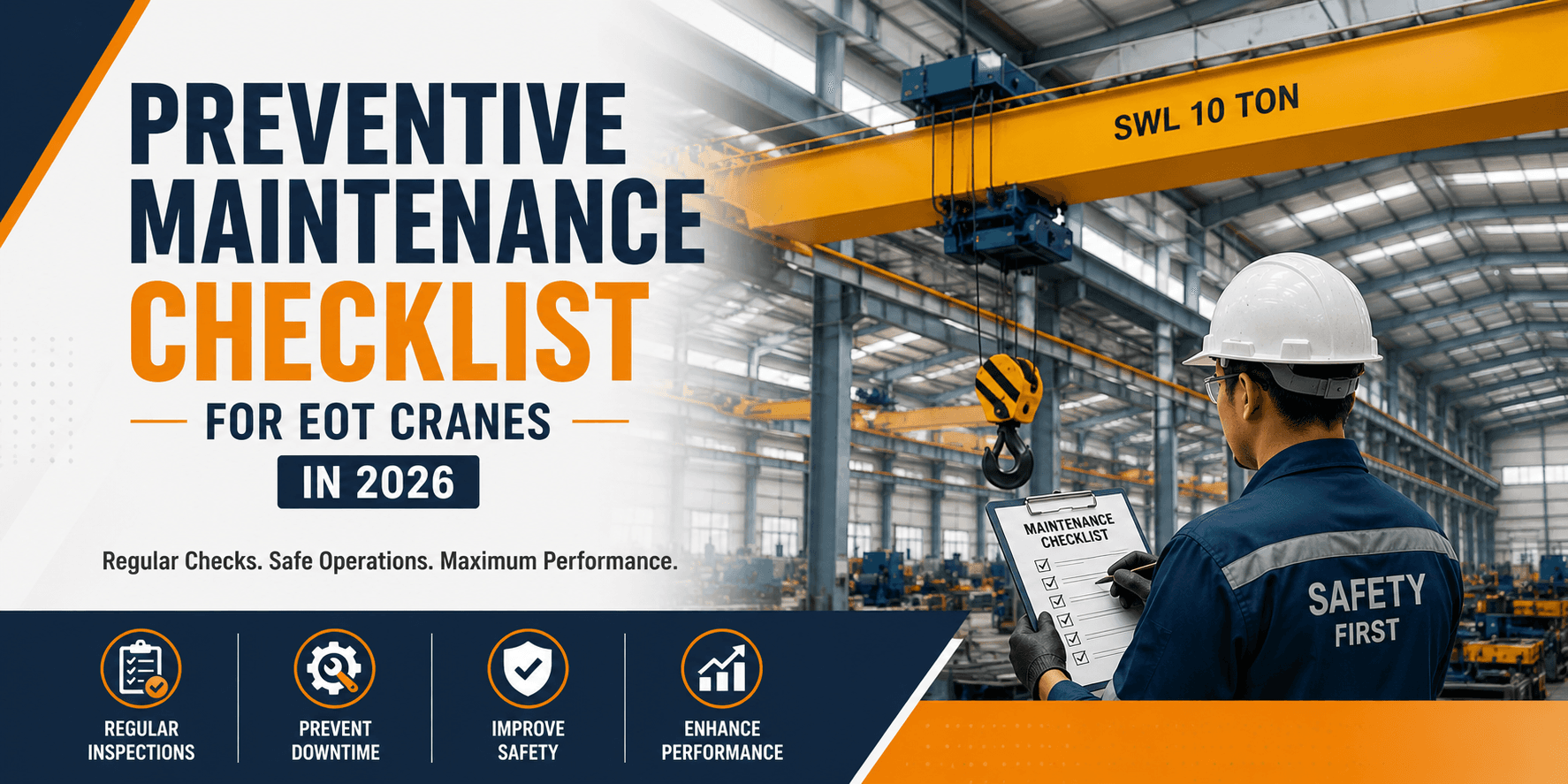
Preventive Maintenance Checklist for EOT Cranes in 2026
An EOT (Electric Overhead Travel) crane operates under heavy loads, continuous cycles, and demanding industrial environments. Without a structured preventive maintenance program, even a well-built crane becomes a liability — causing unexpected downtime, costly repairs, and serious safety hazards for your workforce.
This complete EOT crane maintenance guide covers a structured overhead crane maintenance checklist organized by daily, weekly, monthly, and annual frequency — along with key components to inspect, applicable Indian standards, and the common failure points that cause most crane breakdowns.
Whether you are preparing for an audit, scheduling routine service, or building a crane preventive maintenance program from scratch, this guide is designed to be practical and directly applicable on the shop floor.
Why Preventive Maintenance Matters for EOT Cranes
EOT cranes are critical equipment in most manufacturing and warehousing operations. When a crane fails, it does not just halt one task — it can shut down an entire production line. Yet many facilities still rely on reactive maintenance, fixing cranes only after something breaks.
The cost of neglecting crane maintenance:
- Unplanned crane downtime can cost ₹1–5 lakh per hour in lost production
- Emergency repair parts often cost 3–5× more than planned replacement parts
- Over 80% of crane failures are preventable with a proper maintenance schedule
- Wire rope and hoist brake failures are the leading causes of load drops — both detectable during routine inspection
Preventive maintenance (PM) shifts your operation from reactive to proactive. It extends equipment life, reduces total cost of ownership, ensures compliance with IS:3177 and Factories Act requirements, and most importantly — protects your workers.
Suggested Read:
Want to understand the basics of EOT cranes before maintenance?
Read our Complete Guide to EOT Cranes for Industrial Use to learn about crane types, components, working principles, and industrial applications.
Complete Guide to EOT Cranes for Industrial Use
Key Components Covered in an EOT Crane Inspection
Before running through the checklist, here are the main systems that require attention:
Hoisting Mechanism — Wire rope, drum, sheaves, hook block
Braking System — Hoist brake, travel brake, brake linings
Drive System — Motors, gearboxes, couplings
Runway & Rails — End carriages, wheels, rail joints, end stops
Electrical System — Control panel, festoon cable, limit switches, pendant control
Structural Components — Bridge girder, end trucks, buffers
Safety Devices — Overload limiter, upper limit switch, anti-collision device
Daily EOT Crane Maintenance Checklist
Daily checks are performed by the crane operator before every shift. These are quick visual and functional checks that take 10–15 minutes and catch the most immediate safety risks.
1. Hook & Hook Block : Check for cracks, deformation, latch function, and saddle wear. More than 10% wear means replace immediately.
2. Wire Rope Condition : Look for broken wires, kinks, corrosion, flattening, and correct reeving on the drum.
3. Hoist Brake Test : Lift a load 300mm and release. The load must hold without any drift. If it drifts — take the crane out of service immediately.
4. Upper Limit Switch : Test function before starting work. The hoist must stop before the rope end reaches the drum.
5. Pendant Control : Check all buttons for function and sticking. Cable must not be cut or damaged.
6. Long Travel & Cross Travel : Run both motions and check for smooth operation, no jerking, no unusual noise.
7. End Travel Limit Switches : Verify the crane stops within safe distance from end stops in both directions.
8. Warning Horn / Bell : Must be audible and functional.
9. General Visual Inspection : No oil leaks, no loose components, no bird nests or debris in or around motors.
10. Log Book Entry : Sign the daily check register with shift, date, and operator name.
Stop-Work Criteria (Do Not Operate If):
- Hoist brake drifts even slightly under load
- More than 6 broken wires in any 30D length of rope (IS:3177 discard criteria)
- Any visible crack or deformation on the hook
- Upper limit switch is not functioning
Weekly EOT Crane Inspection Checklist
Weekly inspections are carried out by a maintenance supervisor or trained technician and typically take 45–90 minutes per crane.
1. Wire Rope Lubrication : Apply rope lubricant to full length if the surface appears dry or shows signs of surface oxidation.
2. Hoist Brake Adjustment : Check brake gap. Adjust to manufacturer specification — typically 0.3–0.5mm air gap.
3. Drum Rope Spooling : Check rope layers on drum for correct spooling. No cross-winding or rope jumping out of grooves.
4. Sheave & Sheave Pin Condition : Check groove wear and cracks. Measure groove diameter against rope diameter — excessive groove wear accelerates rope fatigue.
5. Gearbox Oil Level : Check via dipstick or sight glass. Top up if below the minimum mark.
6. Rail & Wheel Alignment : Check for wheel flange contact with rail side. Inspect rail for cracks or lifted joints at fish plates.
7. Festoon Cable / Trailing Cable : No cuts, chafing, or exposed conductors. All cable hangers must be intact and properly spaced.
8. Control Panel : No burnt smell, no loose terminals, all indicator lamps functional.
9. Long Travel Brakes : Test stopping distance. No oil contamination on brake linings.
10. Lubrication Points : Grease all grease nipples: end carriage bearings, cross travel wheels, hook swivel bearing.
11. Buffer & End Stops : Buffers must be intact with no damage. End stops must be securely bolted to the rail.
12. Overload Limiter : Functional test with a calibrated test weight whenever available.
Monthly EOT Crane Maintenance Checklist
Monthly maintenance is a detailed inspection requiring a qualified maintenance engineer. The crane must be taken out of service. Typically takes 2–4 hours per crane.
1. Wire Rope — Full Inspection : Per IS:3177, measure rope diameter reduction, count broken wires in each 30D and 6D length, inspect end terminations and rope anchor at drum.
2. Hook — Dimensional Check : Measure hook throat opening against original dimension. Twist angle must be less than 10°. Use dye penetrant test if any surface crack is suspected.
3. Hoist Motor : Check insulation resistance (must be above 1 MΩ). Check bearing noise, motor temperature under load, and motor mount bolts.
4. Gearbox : Change oil if 3 months have elapsed since last change. Check for metal particles in drained oil. Inspect seals for leaks.
5. Coupling / Coupling Pins : Check flexible coupling elements for wear or cracking. Verify alignment is within tolerance.
6. Bridge Girder : Visual inspection of all welds, especially at end truck connection zones. Check camber and compare against the original baseline measurement recorded at installation.
7. End Carriage & Wheels : Measure wheel diameter for wear. Check flange thickness. Verify tread contact across full rail width. Torque-check all mounting bolts.
8. Electrical Panel : Check contactor contact thickness for wear. Tighten all terminals. Clean dust from panel interior. Verify fuse ratings match specifications.
9. All Limit Switches : Test upper hoist limit, lower hoist limit (if fitted), long travel limits, and cross travel limits under no-load conditions.
10. Runway Rail : Check rail head wear (top and side face). Measure rail joint gaps. Check all rail clips and fish plates for tightness.
11. Festoon System : Inspect all power supply cables and their clips. Check current collector contact surfaces for wear.
12. Structural Bolts : Torque-check all critical fasteners: end truck-to-girder joints, gearbox mounting bolts, motor mounting bolts.
Annual EOT Crane Overhaul & Load Testing
Annual maintenance is a comprehensive overhaul that must be carried out by a certified crane service professional and fully documented. In India, annual load testing is mandatory under the Factories Act 1948 (Section 29) and IS:3177.
Wire Rope: Replace if it meets any IS:3177 discard criteria, regardless of visible appearance. Document rope life hours.
Gearbox: Full oil flush and refill. Internal gear inspection if oil analysis shows contamination or metal particles.
Brakes: Replace all brake linings. Inspect drums or discs for scoring. Calibrate spring tension to specification.
Hoist Motor: Replace bearings. Full motor winding inspection. Thermal imaging under loaded conditions.
Hook Assembly: Magnetic particle inspection (MPI) of the hook body. Replace swivel bearing. Re-certify and re-stamp SWL marking.
Structural Inspection: Non-destructive testing (NDT) of welds at high-stress zones — particularly at end truck connections and mid-span. Check girder camber against original design specification.
Load Test:
- Static test at 125% of Safe Working Load (SWL)
- Dynamic test at 110% SWL
- Issue load test certificate signed by a competent person
Electrical: PAT testing of all electrical equipment. Check and verify earth bonding continuity across the entire crane structure.
Documentation: Update the crane register. Log all replaced parts with part numbers and dates. Renew the inspection certificate.
Top 7 EOT Crane Failure Points & How PM Prevents Them
Wire rope failure — caused by fatigue, corrosion, and over-wear. Prevented by weekly lubrication, monthly wire count inspection, and annual replacement based on life hours.
Brake drift (load creep) — caused by worn linings or incorrect gap. Prevented by daily brake test, weekly gap check, annual lining replacement.
Motor burnout — caused by overloading, poor ventilation, or voltage imbalance. Prevented by monthly insulation resistance test and overload limiter calibration.
Gearbox seizure — caused by oil starvation or seal failure. Prevented by weekly oil level check, 3-monthly oil change, monthly seal inspection.
Rail misalignment or derailment — caused by thermal expansion and loose rail clips. Prevented by monthly clip torque check and quarterly alignment survey.
Two-blocking incident — caused by upper limit switch failure. Prevented by daily functional test of the upper limit switch before operation begins.
Structural fatigue crack — caused by overloading, weld defects, or age. Prevented by annual NDT of girder welds and load test certification.
Applicable Standards for EOT Crane Maintenance in India
IS:3177 : 1999 — Code of practice for electric overhead travelling cranes — covers design, construction, testing, and maintenance requirements.
IS:807 : 2006 — Covers design, erection, and structural testing of cranes and hoists.
IS:13834 — Safety requirements specifically for wire rope hoists.
Factories Act 1948, Section 29 — Mandates annual load testing and maintenance of a formal crane register for all lifting machinery.
ISO 4301 — Crane duty classification system (M1–M8) — used to determine appropriate maintenance intervals for your specific crane.
EN 13001-3-2 — Wire rope design and discard criteria, widely referenced by OEM manufacturers.
Tip — Match PM Frequency to Duty Class:
- M3–M4 (Light duty): Standard monthly PM cycle is adequate
- M5–M6 (Medium duty): Increase wire rope and brake inspections to fortnightly
- M7–M8 (Heavy/very heavy duty): Weekly PM + monthly full inspection + 6-monthly load test
How to Build an EOT Crane PM Program in 6 Steps
Step 1 — Inventory Your Cranes
Document each crane: make, model, SWL, duty class, year of manufacture, and operational hours per shift. This is the baseline for all PM planning.
Step 2 — Create a Maintenance Calendar
Schedule daily, weekly, monthly, and annual checks on a shared maintenance calendar. A CMMS (Computerised Maintenance Management System) is recommended for multi-crane facilities.
Step 3 — Assign Responsibility Clearly
Daily checks — crane operator. Weekly checks — maintenance supervisor. Monthly and annual — qualified engineer or OEM service team. Clear ownership prevents gaps.
Step 4 — Standardise Checklists & Records
Use printed or digital checklists for every inspection level. Maintain a crane register recording every check, fault found, and corrective action taken — this register is also mandatory under the Factories Act 1948.
Step 5 — Train Operators & Technicians
Ensure operators understand what good versus damaged wire rope looks like, how to correctly test the hoist brake, and what the stop-work criteria are. Annual refresher training is best practice.
Step 6 — Partner with Your OEM
Your crane manufacturer has the most detailed knowledge of critical wear points, original part specifications, and correct service intervals. Engage your OEM service team for at least the annual overhaul and load testing.
Conclusion
A structured EOT crane preventive maintenance program is not optional — it is the foundation of safe and productive crane operations. The daily, weekly, monthly, and annual checklists in this guide give you a practical framework that any maintenance team can implement immediately.
At Timeskrane, we have been engineering reliable EOT cranes since 2012 under the TK Crane brand, with over 35 years of industrial legacy behind our designs. Our certified service team offers preventive maintenance contracts, annual load testing, and genuine spare parts for all TK Crane models.
Contact Timeskrane today to discuss a maintenance plan for your cranes:
https://www.timeskrane.com/contact
Frequently Asked Questions
How often should EOT crane maintenance be done?
EOT crane maintenance follows a layered schedule: daily pre-shift checks by the operator (10–15 minutes), weekly inspections by a maintenance supervisor, monthly detailed inspections by a maintenance engineer, and comprehensive annual servicing with load testing by certified professionals. The frequency increases with higher duty classes.
What is included in an EOT crane inspection checklist?
A comprehensive checklist covers the hook and hook block, wire rope condition and lubrication, hoisting mechanism and drum, hoist and travel brakes, end carriages and travel wheels, runway rails, electrical control panel, festoon cables, all limit switches, overload protection, warning horn, and structural integrity of the bridge girder.
What are the main components of EOT crane preventive maintenance?
Four main areas: mechanical systems (wire ropes, hooks, brakes, gearboxes), electrical systems (motors, panels, limit switches, cables), structural components (girders, end trucks, rails), and safety devices (overload limiters, limit switches, alarms). Regular lubrication, oil changes, alignment checks, and periodic load testing complete the program.
What standards govern EOT crane maintenance in India?
Primarily IS:3177 (Code of Practice for EOT Cranes) and the Factories Act 1948, Section 29. IS:807 covers structural testing, IS:13834 covers hoist safety, and ISO 4301 provides the duty classification framework used to set maintenance intervals.
What happens if EOT crane maintenance is neglected?
Equipment failure and unplanned downtime, costly emergency repairs, load drops causing damage or injury, non-compliance with Factories Act requirements, and potential legal liability for the facility. In severe cases, structural failure can cause catastrophic accidents.
Recent Posts
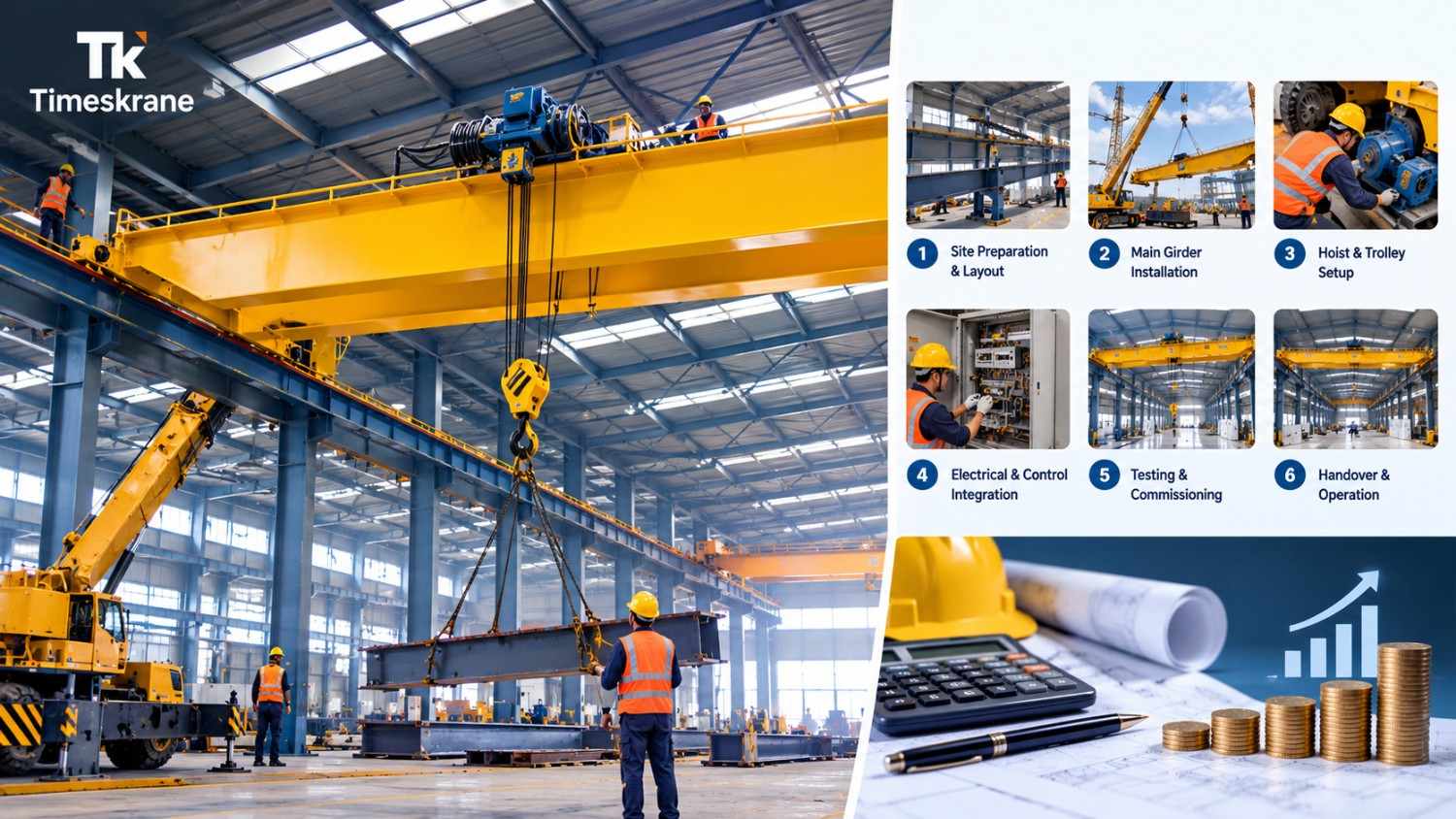
EOT Crane Installation Process and Cost in India
The complete EOT crane installation process in India, covering site survey, runway beams, load testing, and what installation actually costs beyond the crane price.
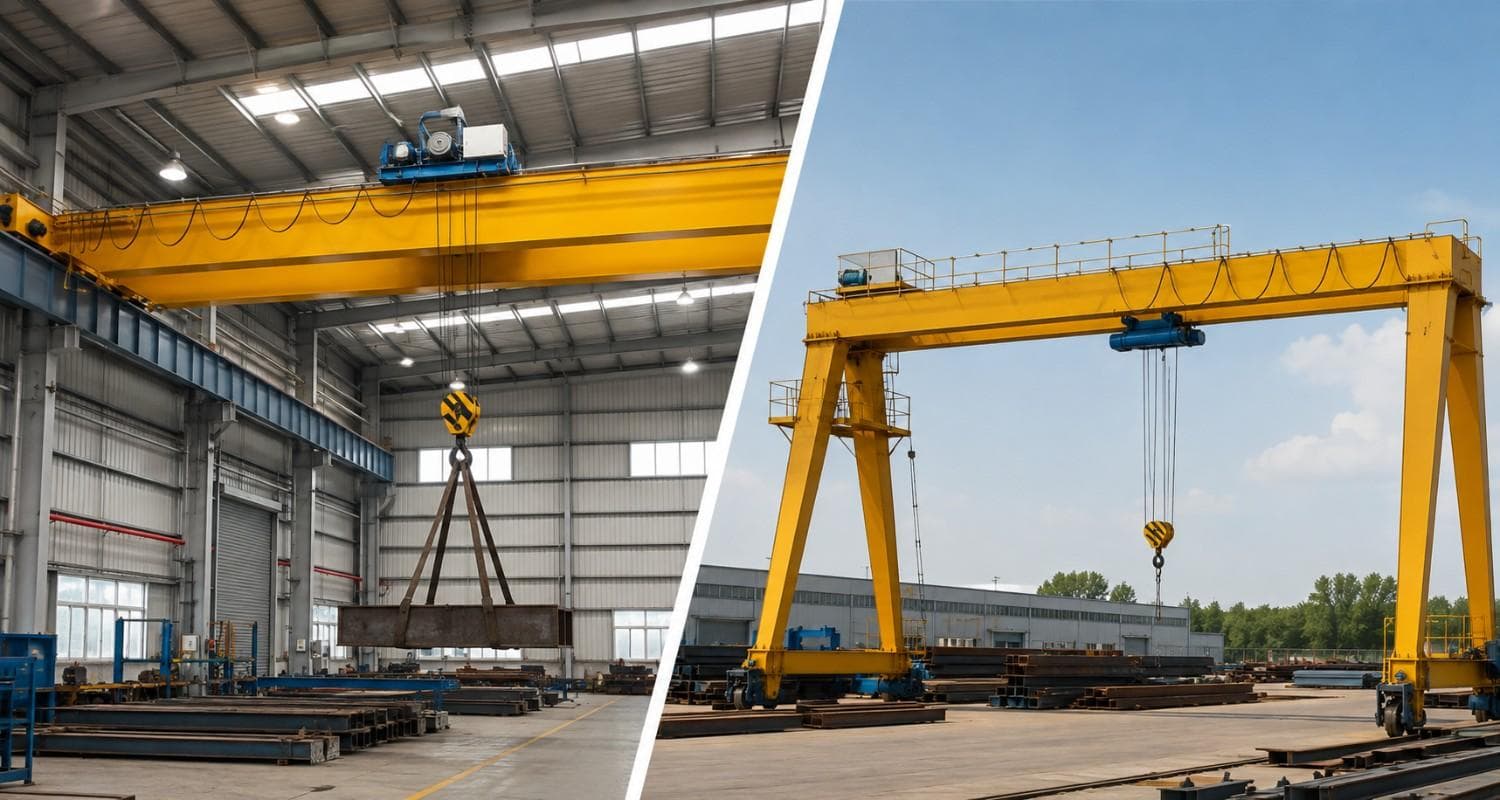
EOT Crane vs Gantry Crane: Which One Does Your Factory Actually Need?
EOT cranes and gantry cranes both lift heavy loads, but they suit very different factories. This guide walks through a simple decision tree covering building structure, floor space, budget, and indoor vs outdoor use, so you can confidently choose the right crane for your facility.

EOT Crane Safety Compliance in India
IS 3177, IS 807, Factories Act rules, and how third-party load testing and certification work for EOT cranes in India.

EOT Crane AMC Cost & Whats Included in 2026
What's actually included in an EOT crane AMC, how comprehensive and non-comprehensive contracts differ, and what drives the cost in India.
Need a Custom Lifting Solution?
Let’s Talk!
Looking for a reliable partner for your next industrial project?
- Expert Consultation
- Pan-India Service