
Where to Buy Genuine KONE Spare Parts in India
Table of Content
Where to Buy Genuine KONE Spare Parts in India
It starts with a small symptom. A brake that feels slightly soft. A hoist that sounds different during the lift. A limit switch that trips inconsistently. Any experienced crane operator or maintenance engineer will tell you that these are not minor inconveniences to be noted and ignored. They are early warnings that a component is approaching the end of its serviceable life and needs to be replaced before it fails completely.
The next question is always the same. Where do you get the right part quickly, and how do you know it is genuine?
For plant managers and maintenance teams operating KONE crane systems across India, sourcing KONE spare parts is a challenge that comes up regularly. The Indian market has no shortage of suppliers offering crane components at attractive prices. The problem is that not all of them are selling what they claim to be selling. Counterfeit and substandard parts in the crane spare parts market are a real and documented problem, and the consequences of fitting the wrong part to a safety-critical piece of lifting equipment can be severe.
This blog is a practical guide to navigating the KONE spare parts market in India. It covers what to look for, where to buy, how to verify authenticity, and why the source of your spare parts matters far more than the price on the invoice.
Why the Source of KONE Spare Parts Matters More Than the Price
A crane is a safety-critical machine. Every component in its mechanical and electrical system has been engineered to specific tolerances, load ratings, and performance parameters. When a genuine component is replaced with a substandard or counterfeit alternative, those parameters change in ways that are not always immediately visible.
A brake lining made from the wrong friction material may appear identical to a genuine KONE spare part. It will fit the same housing and bolt to the same mounting points. But its actual braking performance, particularly under repeated cycling and thermal loading, may be significantly inferior. That difference will not show up during a routine inspection. It may only reveal itself when the brake is called upon to hold a full load at height, at which point the consequences of a failure are obvious.
The same logic applies to wire ropes, electrical contactors, overload relays, gearbox seals, and virtually every other component in a KONE crane system. The original component was designed and tested to perform reliably under defined conditions. A substitute that has not been manufactured to the same specification introduces uncertainty into a system where certainty is required.
This is not a theoretical concern. Maintenance teams across Indian industry have experienced premature component failures, unexpected breakdowns, and in some cases safety incidents that were traced back to non-genuine spare parts fitted during maintenance. The short-term saving on the part cost was far outweighed by the consequential costs.
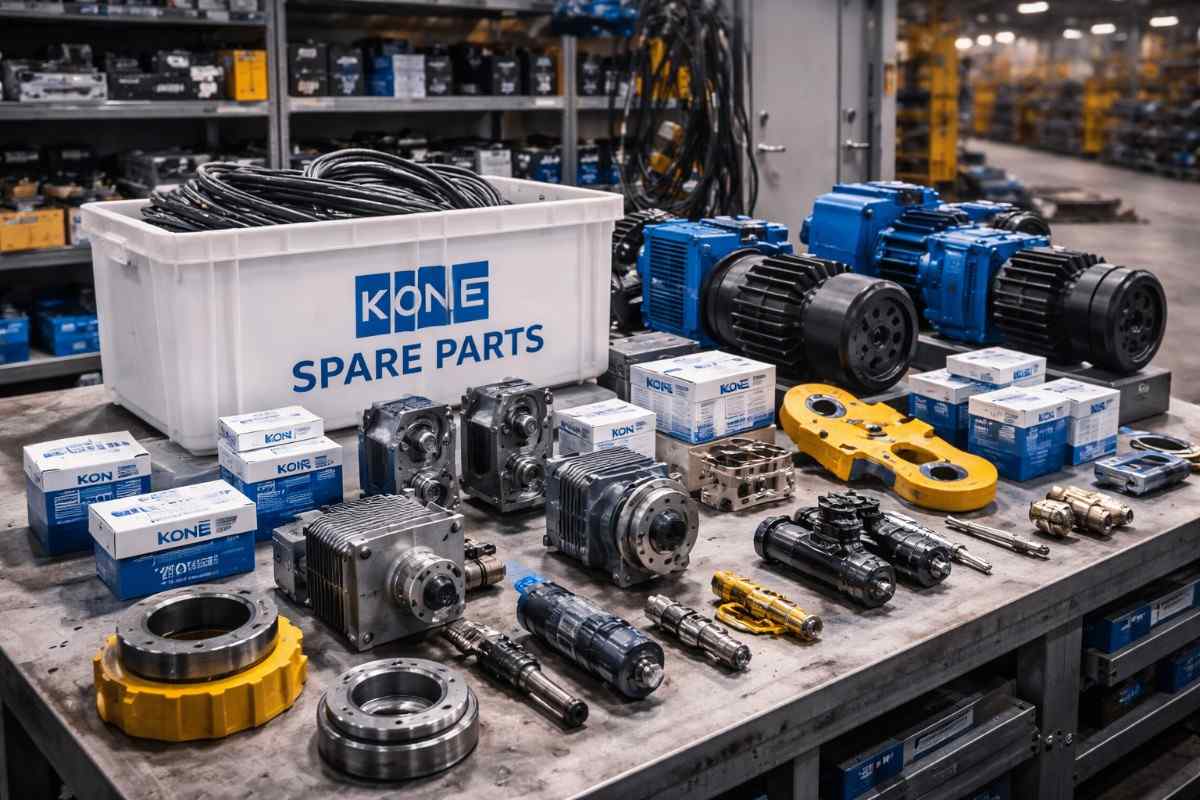
Understanding the KONE Spare Parts Range
Before discussing where to buy, it helps to understand the categories of KONE spare parts that maintenance teams most commonly need.
Mechanical Wear Parts
These are the components that experience direct physical wear through normal crane operation and need to be replaced periodically. They include brake linings and brake drum assemblies, wire ropes and rope fittings, hook assemblies and swivel bearings, end truck wheels and axles, and gearbox seals and gaskets. These parts have defined replacement intervals based on operating hours and duty cycles, and tracking them proactively is the foundation of good crane maintenance.
Electrical and Control Components
Crane electrical systems include components that are subject to wear from switching cycles, thermal stress, and environmental exposure. Contactors and overload relays, limit switches, pendant control units and cables, motor brushes and slip rings, and control panel components all fall into this category. Electrical faults are among the most common causes of crane downtime, and using genuine components in repairs ensures that the repaired system performs to its original specification.
Hoist Components
The hoist is the most intensively used sub-system on any crane. Hoist spare parts including rope drums, rope guides, gearbox components, motor couplings, and hoist brake assemblies are subject to significant wear in high-duty-cycle applications. KONE hoist systems are precision-engineered, and the tolerances involved mean that genuine replacement parts are particularly important in this area.
Structural and Safety Components
End stops, buffers, rail clamps, and safety hooks may not need replacement frequently, but when they do need replacing, using components that meet the original specification is non-negotiable. These are the parts that protect the crane and its load in abnormal operating situations.
The Counterfeit Parts Problem in India's Crane Spare Parts Market
India's industrial spare parts market is large, fragmented, and poorly regulated in terms of product authenticity. For high-volume consumable parts like brake linings and wire ropes, the presence of substandard and counterfeit products is a well-known industry issue.
The problem is compounded by the way spare parts are often sourced. Maintenance teams under budget pressure look for the lowest cost option. Local spare parts traders, who may genuinely not know the provenance of what they are selling, supply parts that look correct but are not manufactured to specification. The physical similarity between a genuine part and a counterfeit is often close enough that even an experienced technician cannot tell the difference without testing.
Several markers help distinguish genuine KONE spare parts from substitutes. Genuine parts carry part numbers that match the KONE parts catalogue for the specific crane model. They come with appropriate packaging that includes the manufacturer's branding and traceability information. Material test certificates are available for structural components. And the supplier can provide a documented supply chain that connects the part back to an authorised source.
A local spare parts trader who cannot provide any of this documentation is not necessarily selling counterfeit parts deliberately, but they cannot provide the assurance that safety-critical applications demand.
How to Identify an Authorised KONE Spare Parts Supplier in India
The most reliable way to source genuine KONE spare parts in India is through authorised and established suppliers who have a documented relationship with the KONE supply chain.
Here is what to look for when evaluating a spare parts supplier.
Verifiable supply chain documentation. A genuine supplier should be able to tell you where the parts came from and provide documentation that supports that claim. This does not need to be complex. An invoice trail, a manufacturer's certificate, or an authorisation letter from the principal company is sufficient. What is not sufficient is a verbal assurance with no supporting paperwork.
Part number matching. Every KONE crane component has a specific part number that corresponds to the crane model and serial number. A reliable supplier will cross-reference your crane's serial number or model details against the parts catalogue before supplying components. If a supplier is willing to supply parts without confirming the part number match, that is a warning sign.
Technical knowledge. A trustworthy KONE spare parts supplier has technical knowledge of the products they sell. They can advise on correct replacement intervals, installation requirements, and compatibility with your specific crane model. A supplier who cannot answer basic technical questions about the parts they are selling is not in a position to guarantee their authenticity or suitability.
After-sales accountability. What happens if the part does not fit correctly or fails prematurely? A genuine supplier stands behind what they sell and will resolve problems. A grey market trader typically does not.
Established business presence. Check how long the supplier has been operating, whether they have a physical facility, and whether they have verifiable references from other industrial clients. Longevity and a traceable business history are basic credibility markers.
A Practical Step-by-Step Guide to Ordering KONE Spare Parts
Following a structured process when ordering spare parts reduces the risk of receiving wrong or substandard components.
Step one is to identify the crane model and serial number. This information is on the crane's nameplate, which is typically located on the end truck or main girder. Every parts order should start with this information because KONE crane components vary between models and production years.
Step two is to identify the specific part required. Use the fault symptoms, the component location, and if available the crane's original parts manual to identify the correct part number. If you do not have the parts manual, a knowledgeable supplier or service provider can help identify the part from the crane details.
Step three is to contact an authorised supplier with the crane model, serial number, and part number. Request confirmation that the part being supplied matches the specified part number and ask for the available documentation.
Step four is to verify the part on receipt before installation. Check that the part number on the component or packaging matches what was ordered. Check the physical condition of the part. For critical components, request the material certificate or test documentation before signing off on receipt.
Step five is to document the replacement in the crane's maintenance record. Recording what was replaced, when, and with what part number builds a maintenance history that is valuable for future servicing, warranty claims, and statutory inspection compliance.
Common Problems That Drive Urgent Spare Parts Requests and How to Avoid Them
Brake lining failure during operation. This is one of the most common emergency spare parts situations. It is also almost entirely preventable. Brake linings have defined wear limits and should be checked and measured at every service visit. Keeping a spare set of brake linings in stock on site eliminates the risk of downtime while parts are sourced.
Wire rope failure. Wire rope has a defined service life based on operating cycles, load, and environmental conditions. Regular rope inspections including broken wire counts and diameter measurements allow rope replacement to be planned in advance rather than triggered by a sudden failure.
Limit switch malfunction. Limit switches are subject to mechanical wear and environmental contamination. They are relatively low-cost components that should be replaced at the first sign of inconsistent operation rather than after a complete failure that leaves the crane inoperable.
Contactor failure causing loss of crane motion. Contactors wear through switching cycles and eventually fail to make reliable contact. Keeping a set of commonly used contactors as on-site stock is a simple and low-cost insurance against unplanned downtime.
The common thread across all of these scenarios is that proactive maintenance and planned spare parts stocking is far less disruptive and less expensive than emergency sourcing and reactive repair.
Times Krane: A Trusted Source for KONE Spare Parts in India
Times Krane supplies genuine KONE spare parts to industrial clients across India as part of its comprehensive crane service and support offering. The Times Krane team understands the KONE crane product range in depth, which means that parts are identified correctly, supplied with appropriate documentation, and backed by technical support that helps maintenance teams fit and use them correctly.
For clients operating KONE crane fleets, Times Krane can also assist with spare parts planning. Based on the crane model, duty class, and operating history, the team can recommend a strategic inventory of fast-moving and critical spare parts that should be kept on site to minimise downtime risk. This kind of proactive parts management turns the spare parts supply relationship from a transactional purchase into a genuine maintenance support partnership.
Times Krane also integrates spare parts supply with its service and AMC offering. Clients on annual maintenance contracts benefit from planned parts procurement at standard pricing, advance availability of components ahead of scheduled service visits, and a single point of contact for all crane service and parts requirements.
Applications and Industries Where KONE Spare Parts Supply Is Critical
In steel plants and rolling mills, KONE cranes operate under extreme duty conditions where component wear rates are high. Regular and reliable access to genuine KONE spare parts for brakes, wire ropes, and electrical systems is essential for maintaining production continuity.
In automotive manufacturing facilities, precision in crane operation directly affects assembly quality and line efficiency. Electrical control components and hoist spare parts need to be genuine to maintain the performance accuracy these applications demand.
In warehousing and logistics operations, crane availability during peak periods is commercially critical. Keeping essential KONE spare parts in stock on site is the most reliable way to ensure that a minor component failure does not turn into a multi-day crane outage.
In heavy engineering and fabrication workshops, cranes handle irregular and demanding loads throughout each shift. Hook assemblies, wire ropes, and brake components experience accelerated wear in these environments and need to be monitored and replaced on a planned schedule.
Frequently Asked Questions
How do I know if the KONE spare parts I am buying are genuine?
Ask the supplier for part number confirmation matched to your crane model and serial number, request supply documentation tracing the part back to an authorised source, and check that packaging carries appropriate manufacturer identification. If a supplier cannot provide these, the part's authenticity cannot be confirmed.
Can I use compatible or equivalent parts instead of genuine KONE spare parts?
For non-critical consumables, compatible parts may be acceptable in some situations, provided they meet the same dimensional and performance specifications. For safety-critical components such as brake assemblies, wire ropes, overload protection devices, and structural parts, genuine parts are strongly recommended. Using non-genuine parts on safety-critical components can affect crane performance and may also affect insurance and statutory compliance.
How quickly can Times Krane supply KONE spare parts across India?
Times Krane maintains stock of fast-moving KONE spare parts and can supply to most industrial locations across India within a few working days. For urgent requirements, expedited supply arrangements can be discussed directly with the Times Krane team.
Should I keep KONE spare parts in stock on site or order as needed?
For cranes operating in production-critical applications, keeping a defined set of fast-moving spare parts on site is strongly recommended. The Times Krane team can advise on a suitable on-site inventory based on your crane model and operating profile.
Does Times Krane provide technical support for fitting KONE spare parts?
Yes. Times Krane provides technical support both remotely and through on-site service visits for the installation and commissioning of KONE spare parts. For complex replacements such as hoist gearbox components or motor assemblies, on-site support from a trained technician is recommended.
Conclusion
Sourcing KONE spare parts in India does not have to be a process filled with uncertainty and risk. But it does require deliberate choices about where to buy, what documentation to demand, and how to build a supply relationship that supports your maintenance programme reliably over time.
The consequences of fitting the wrong part to a safety-critical crane are simply too significant to leave to chance or to the lowest bidder on a parts trading platform. Genuine KONE spare parts, sourced through a knowledgeable and accountable supplier, protect your crane's performance, your team's safety, and your operation's continuity.
Times Krane is ready to be that supplier for your facility. Whether you need a single urgent part or want to put a structured spare parts management programme in place for your entire KONE crane fleet, the Times Krane team has the product knowledge, the supply capability, and the service commitment to support you effectively. Reach out today and let us help you keep your cranes running the way they were built to run.
Recent Posts
EOT Crane Installation Process and Cost in India
The complete EOT crane installation process in India, covering site survey, runway beams, load testing, and what installation actually costs beyond the crane price.
EOT Crane vs Gantry Crane: Which One Does Your Factory Actually Need?
EOT cranes and gantry cranes both lift heavy loads, but they suit very different factories. This guide walks through a simple decision tree covering building structure, floor space, budget, and indoor vs outdoor use, so you can confidently choose the right crane for your facility.

EOT Crane Safety Compliance in India
IS 3177, IS 807, Factories Act rules, and how third-party load testing and certification work for EOT cranes in India.

EOT Crane AMC Cost & Whats Included in 2026
What's actually included in an EOT crane AMC, how comprehensive and non-comprehensive contracts differ, and what drives the cost in India.
Need a Custom Lifting Solution?
Let’s Talk!
Looking for a reliable partner for your next industrial project?
- Expert Consultation
- Pan-India Service