
How Do You Pick the Best Industrial EOT Cranes Manufacturers
Table of Content

How Do You Pick the Best Industrial EOT Cranes Manufacturers
Every year, plant managers and procurement heads across manufacturing, steel, logistics, and heavy engineering make a decision that will shape their facility's productivity for the next fifteen to twenty years. They choose an EOT crane manufacturer. Some get it right. Many do not realize they got it wrong until the equipment is installed, the warranty period has passed, and the breakdowns begin.
Choosing among industrial EOT crane manufacturers is not a straightforward comparison of specifications on a datasheet. It requires evaluating engineering capability, manufacturing quality, application experience, customization depth, and long-term service commitment. This guide gives you a structured, practical framework to make that decision with confidence and clarity.
Understanding What an EOT Crane Manufacturer Actually Does
Before evaluating manufacturers, it is worth being precise about what you are actually buying. An Electric Overhead Travelling crane is not a single product. It is an engineered system comprising a structural steel bridge, end carriages, hoist unit, travel mechanisms, electrical control system, runway structure, and a range of application-specific accessories.
A genuine EOT crane manufacturer designs and builds this system as an integrated whole. They are not assembling imported components into a local frame. They have in-house structural engineering capability, manufacturing facilities, quality control processes, and a service infrastructure. The distinction matters because the performance of the final system depends on how well all these elements work together, and that integration is only possible when a single manufacturer owns the entire design and build process.
When you evaluate manufacturers, your first filter should be whether they are genuine manufacturers or sophisticated resellers. The difference will define your experience at every stage from specification to commissioning to the service call three years later.
The Eight Criteria That Separate Good Manufacturers from Great Ones
1. Engineering and Design Capability
The quality of an EOT crane begins before a single piece of steel is cut. It begins on the drawing board, in the structural calculations, in the duty cycle analysis, and in the decisions made about how each component will interact with the others under real operating conditions.
Strong EOT crane manufacturers maintain in-house mechanical and electrical engineering teams. They conduct proper duty cycle calculations based on FEM or IS crane classifications. They perform structural analysis on the bridge girder and end carriages. They size motors, gearboxes, and brakes to actual load and usage data rather than applying standard catalogue selections to every application.
When meeting a prospective manufacturer, ask them to walk you through their design process for a crane similar to yours. The depth and confidence of their answer will tell you a great deal about whether engineering is a core competency or a background function.
2. Manufacturing Facility and Process Quality
A crane manufacturer's factory is where promises become products. Visiting the manufacturing facility, even briefly, provides insight that no brochure or presentation can match. What you are looking for is evidence of systematic quality at every production stage.
Key indicators of manufacturing quality include:
- Dedicated structural fabrication area with jigs and fixtures for consistent girder geometry
- Qualified welders with documented procedural qualifications following IS 2751 or equivalent standards
- In-process dimensional inspection with calibrated measuring equipment
- Shot blasting and surface preparation equipment for correct paint adhesion
- Electrical assembly area with organized cable management and documented wiring standards
- Load test facility for factory acceptance testing before despatch
Manufacturers who cannot demonstrate these capabilities are likely producing cranes that meet specifications on paper but fall short in the details that determine long-term reliability.
3. Product Range and Configuration Depth
Your current requirement might be a straightforward 10-tonne single girder crane for a fabrication workshop. But your facility will evolve. Production volumes change, processes change, and the lifting requirements that seem simple today may become significantly more complex over time.
Evaluating a manufacturer's product range tells you two things: their engineering depth and their ability to grow with you. A manufacturer who offers only a narrow range of standard configurations will eventually become a constraint. A manufacturer with genuine capability across single girder and double girder systems, standard and process crane configurations, indoor and outdoor applications, and a range of hoist types and control options can accommodate your changing requirements without forcing you to switch suppliers.
Specifically look for manufacturers who offer:
- Single girder EOT cranes for light to medium duty applications
- Double girder EOT cranes for heavy duty and precision applications
- Underslung and top-running configurations
- Process cranes for steel, foundry, and chemical environments
- Explosion-proof configurations for hazardous area classifications
- KBK modular crane systems for flexible intralogistics applications
4. Compliance with Standards and Certifications
Industrial EOT cranes operate as safety-critical lifting equipment. The standards that govern their design, manufacture, and testing exist because inadequate cranes injure and kill people and damage facilities. A credible manufacturer takes compliance seriously and can demonstrate it.
Relevant standards for EOT crane manufacturers in India and export markets include:
- IS 3177: Code of practice for electric overhead travelling cranes
- IS 807: Code of practice for design, manufacture, erection, and testing of cranes and hoists
- ISO 4301: Classification of cranes by duty group
- FEM 1.001: Rules for the design of hoisting appliances
- IS 15560: Safety code for cranes
- CE marking requirements for cranes supplied to European markets
Ask any manufacturer to show you their quality management system certification, their compliance documentation for the specific standards applicable to your crane, and their factory test procedures. Reluctance or vagueness in response to these requests is a meaningful signal.
5. Customization Capability
Standard cranes solve standard problems. Most industrial applications have at least some element that deviates from the catalogue: a tight headroom constraint, an unusual span, a corrosive atmosphere requiring special surface treatment, a process requirement that demands a non-standard hook approach, or an integration requirement with an existing automation system.
The best EOT crane manufacturers have engineering teams capable of genuine customization. Not cosmetic variation on a standard product but real design adaptation that addresses your specific operational requirements. This might involve:
- Custom girder depth for headroom-critical installations
- Non-standard span configurations to match existing column spacing
- Dual hoist arrangements for tandem lifting operations
- Festoon systems rated for outdoor use in coastal environments
- Integration with SCADA or factory automation systems
- Special paint systems for chemical resistance
When evaluating manufacturers on customization, ask for examples of non-standard projects they have completed for clients with requirements similar to yours. Generic claims about flexibility are less useful than specific project references.
6. Installation and Commissioning Competence
The quality of the crane that arrives at your facility is only part of the story. How it is installed determines how it performs. Incorrect runway alignment, improper end carriage geometry, inaccurate limit switch settings, and poorly configured drive parameters are all installation-stage failures that compromise a well-manufactured crane from day one.
The best manufacturers deploy their own trained installation teams rather than subcontracting to third parties who have no product-specific knowledge. They follow documented installation procedures, use proper alignment tools, and conduct a structured commissioning process that includes:
- Runway geometry verification before bridge installation
- Bridge alignment check on the runway
- Load testing at factory acceptance load levels
- Functional testing of all safety devices and limit functions
- Control system parameter verification and documentation
- Operator and maintenance staff handover training
Ask prospective manufacturers specifically who installs their cranes and how the commissioning process is documented. A handover certificate and commissioning report should be standard deliverables, not optional extras.
7. After-Sales Service and Spare Parts Support
An EOT crane installed today should remain in productive service for fifteen to twenty years or more. Over that period, the relationship between your facility and the crane manufacturer will be defined far more by after-sales service than by the initial supply experience.
The strongest EOT crane manufacturers invest heavily in their service infrastructure. They maintain regional service teams. They stock genuine spare parts with short lead times. They offer structured preventive maintenance contracts. They have emergency breakdown response capabilities with committed response times.
Evaluate service capability on these specific dimensions:
- Geographic proximity of service engineers to your facility
- Availability of original or OEM-equivalent spare parts without excessive lead times
- Preventive maintenance contract terms and scope of work
- Emergency response time commitment in writing
- Ability to support older crane models with parts and technical knowledge
- Remote diagnostics capability for electronically controlled cranes
The service question is often the most revealing one to ask during manufacturer evaluation. How a manufacturer responds tells you how seriously they take the relationship beyond the point of sale.
8. Industry References and Application Experience
There is no substitute for demonstrated experience in your specific industry. A crane manufacturer who has successfully supplied and supported cranes in steel plants understands the thermal environment, the duty cycle demands, the maintenance access constraints, and the process-specific requirements that a generalist manufacturer may simply not anticipate.
Ask prospective manufacturers for references in your industry. Speak to maintenance managers and plant engineers at reference sites rather than just procurement contacts. Ask about installation experience, post-commissioning issues, service response quality, and whether they would buy from the same manufacturer again. These conversations consistently reveal information that no sales presentation will ever include.
Red Flags to Watch for During Manufacturer Evaluation
Experience across many industrial procurement processes reveals certain warning signs that predict a poor supplier relationship. Watch for:
- An inability to provide stamped structural calculations or load analysis documentation
- Reluctance to allow a factory visit or inspection of manufacturing processes
- Vague or non-committal answers about service coverage and spare parts availability
- References who cannot be contacted directly or who provide only generic endorsements
- Significantly lower pricing than comparable manufacturers without clear explanation of where the cost reduction comes from
- A sales process that jumps to commercial terms before fully understanding your technical requirements
Any of these individually warrants further scrutiny. Multiple red flags in a single evaluation process should lead to removal of that manufacturer from consideration regardless of commercial attractiveness.
Single Girder vs Double Girder: A Buying Decision That Starts With Your Application
One of the most consequential choices in EOT crane specification is the structural configuration. This decision should be driven entirely by your application requirements, not by cost alone.
Single girder cranes are appropriate for lower capacities, typically up to 15 to 20 tonnes, where headroom is limited, building structure load capacity is constrained, or the duty cycle is light to medium. They are cost-effective, easy to install, and well-suited to fabrication shops, warehouses, and light manufacturing applications.
Double girder cranes are the correct choice for heavier capacities, higher duty cycles, applications requiring underslung hook travel to the full crane span, precision positioning requirements, or process environments where the crane must carry specialized lifting attachments. They also provide better access for maintenance of the hoist unit.
A manufacturer who recommends a configuration before properly understanding your operational parameters is not providing engineering guidance. They are defaulting to their most convenient product. Insist on a proper application analysis before accepting any structural configuration recommendation.
Industries Where EOT Crane Manufacturer Selection Is Most Critical
Certain industries demand more from their EOT crane manufacturers than others. Understanding where the stakes are highest helps calibrate the evaluation process.
Steel and metals processing requires cranes that handle extreme temperatures, abrasive atmospheres, and continuous heavy duty cycles. Manufacturer experience with ladle cranes, charging cranes, and coil handling cranes is essential.
Automotive manufacturing demands precision, reliability, and integration with automated production lines. Cranes in body shops and press areas must deliver consistent positioning accuracy across millions of operating cycles.
Pharmaceutical and food processing requires cranes built with hygienic design principles, stainless steel components in contact zones, and paint systems that resist cleaning chemicals.
Port and outdoor logistics applications expose cranes to marine atmospheres, wind loading, and temperature extremes that demand specific corrosion protection and structural design considerations.
Heavy fabrication and shipbuilding requires very large span cranes with high capacity, tandem lifting capability, and robust structural designs for hard service conditions.
In each of these sectors, a manufacturer without direct application experience is at a significant disadvantage regardless of general competence.
Why Times Krane Stands Out Among Industrial EOT Crane Manufacturers
Times Krane brings together genuine manufacturing capability, engineering depth, and a service-first philosophy that addresses the full lifecycle of industrial crane ownership.
The approach begins with proper application analysis. Before any design work starts, the Times Krane engineering team understands the operational environment, duty cycle, building constraints, and process requirements specific to your facility. This analysis drives every subsequent design and manufacturing decision.
Manufacturing quality is maintained through documented processes, qualified welding procedures, in-process inspection, and factory load testing before any crane leaves the facility. Installation is carried out by trained Times Krane engineers following structured commissioning procedures that result in properly documented handover.
After commissioning, Times Krane remains a committed service partner. With structured preventive maintenance programs, genuine spare parts availability, and trained field service engineers, the relationship continues to deliver value through the full operating life of the equipment.
For industrial buyers who understand that the real cost of a crane is determined over its entire service life rather than at the point of purchase, Times Krane represents a partnership built on engineering integrity and long-term reliability.
Explore EOT crane products and capabilities at timeskrane.com
Frequently Asked Questions
Q1: What is the typical lifespan of an EOT crane from a quality manufacturer? A well-designed and properly maintained EOT crane from a quality manufacturer should deliver twenty or more years of productive service. Lifespan is heavily influenced by duty cycle, maintenance quality, and the operating environment. Cranes in heavy duty steel applications may require structural assessment and modernization after fifteen years while lighter duty cranes in controlled environments routinely exceed twenty-five years of service.
Q2: How do I verify that an EOT crane manufacturer's quality claims are genuine? Request documented evidence rather than accepting verbal assurances. Ask for quality management system certification, welding procedure qualification records, a sample factory test report, and contact details for reference customers you can speak with directly. A manufacturer who welcomes this level of scrutiny is demonstrating confidence in their quality. One who deflects or delays is telling you something important.
Q3: Should I always choose the manufacturer with the most product certifications? Certifications are a necessary baseline, not a sufficient differentiator. They confirm that minimum standards are met but they do not distinguish between manufacturers who barely meet those standards and those who significantly exceed them. Use certifications as a filter to eliminate unqualified manufacturers and then evaluate the remaining candidates on engineering capability, application experience, and service quality.
Q4: Is it better to source an EOT crane from a local manufacturer or a national supplier? Both models have advantages. Local manufacturers may offer faster installation response and more accessible service teams. National suppliers may offer broader product range and more extensive application experience. The most important factor is not geography but genuine manufacturing capability and service commitment. A national manufacturer with a strong regional service presence often delivers the best of both.
Q5: What documentation should I receive with a new EOT crane from a quality manufacturer? Complete documentation from a quality manufacturer should include structural design calculations, electrical schematic drawings, equipment data plates and component data sheets, factory test report with load test certificate, spare parts manual with part numbers, operation and maintenance manual, installation and commissioning report, and warranty documentation. Any manufacturer who cannot provide this complete package is not operating to a professional standard.
Conclusion
Picking the best industrial EOT crane manufacturers is a decision that rewards careful, methodical evaluation. The criteria covered in this guide, from engineering capability and manufacturing quality to customization depth, standards compliance, and after-sales service infrastructure, provide a complete framework for separating manufacturers who will genuinely serve your long-term interests from those who will deliver a crane and disappear.
The upfront investment of time in thorough manufacturer evaluation pays back many times over across the operating life of equipment that your facility depends on every day.
When you are ready to discuss your EOT crane requirement with a manufacturer who takes engineering and service as seriously as you take your production targets, Times Krane is ready to engage.
Reach out to the Times Krane team today at timeskrane.com and begin the conversation about the right EOT crane solution for your facility.
Recent Posts
EOT Crane Installation Process and Cost in India
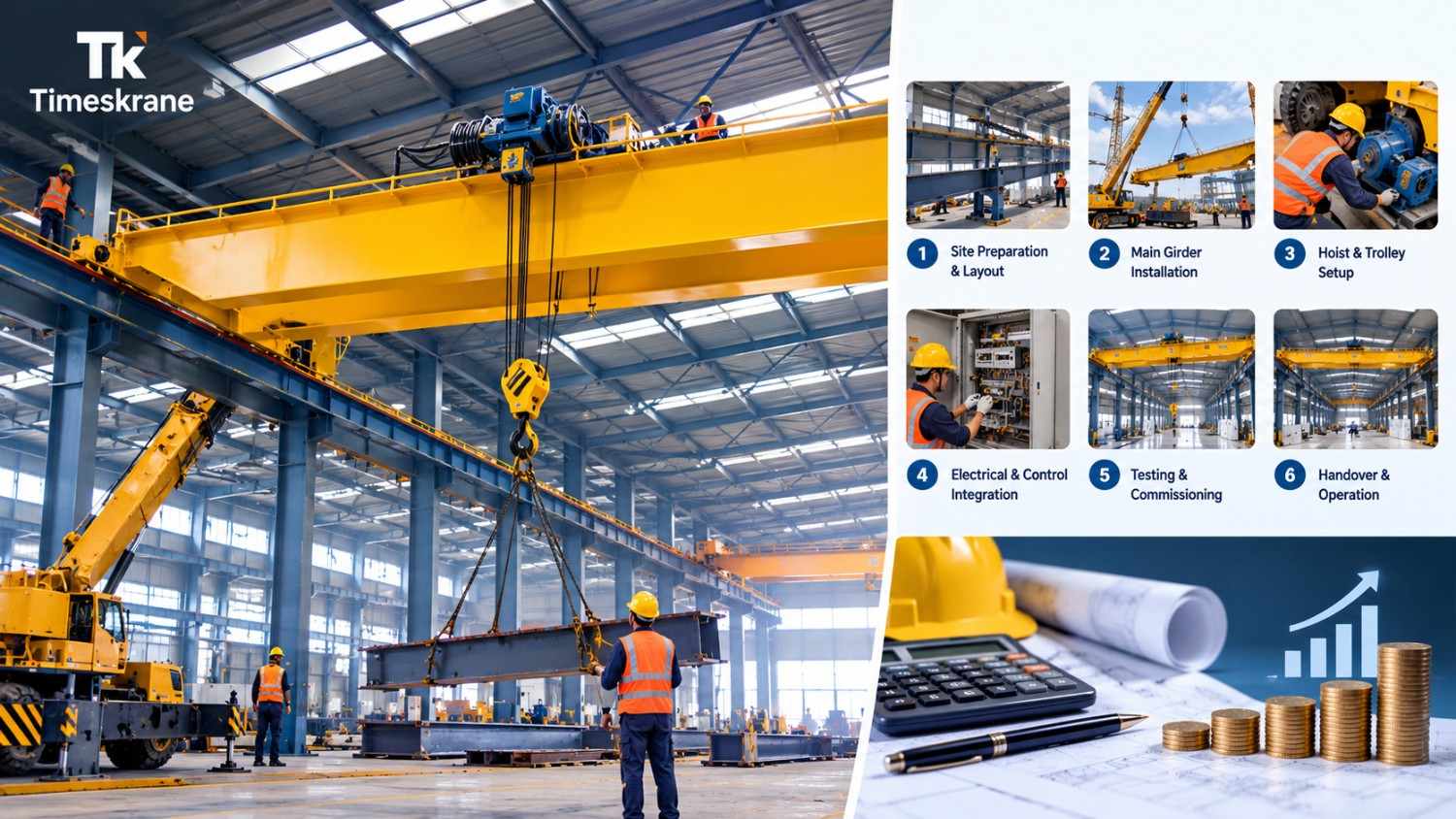
The complete EOT crane installation process in India, covering site survey, runway beams, load testing, and what installation actually costs beyond the crane price.
EOT Crane vs Gantry Crane: Which One Does Your Factory Actually Need?
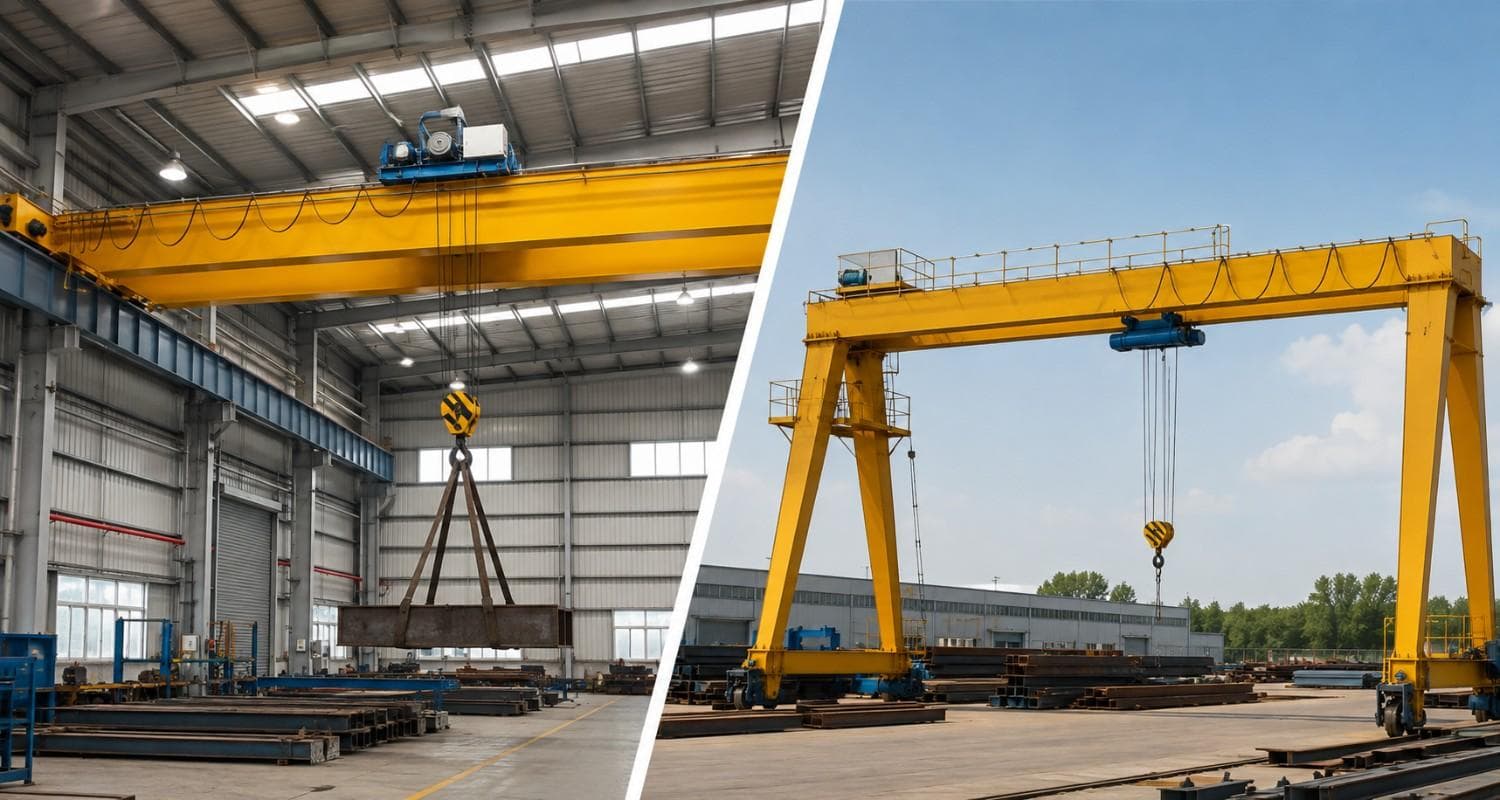
EOT cranes and gantry cranes both lift heavy loads, but they suit very different factories. This guide walks through a simple decision tree covering building structure, floor space, budget, and indoor vs outdoor use, so you can confidently choose the right crane for your facility.

EOT Crane Safety Compliance in India
IS 3177, IS 807, Factories Act rules, and how third-party load testing and certification work for EOT cranes in India.

EOT Crane AMC Cost & Whats Included in 2026
What's actually included in an EOT crane AMC, how comprehensive and non-comprehensive contracts differ, and what drives the cost in India.
Need a Custom Lifting Solution?
Let’s Talk!
Looking for a reliable partner for your next industrial project?
- Expert Consultation
- Pan-India Service